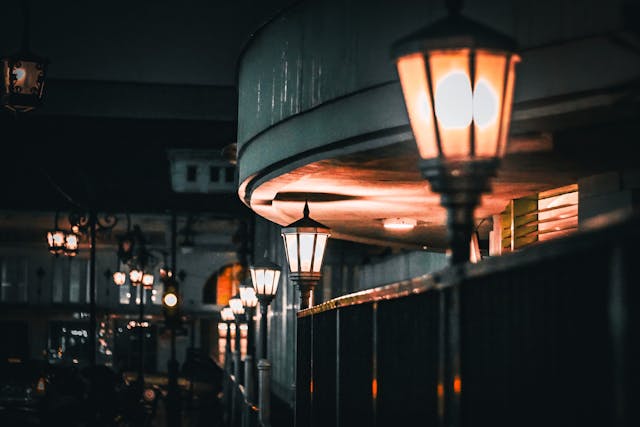
Explore gas street lamps history, from early coal-gas experiments to the illuminated cities that transformed life after sunset.
Gas street lamps were the world’s first widely adopted modern street lighting system. Developed from coal-gas technology in the late 18th century and first publicly demonstrated in London in 1807, they transformed dark, dangerous streets into illuminated public spaces and paved the way for modern urban life.
It’s difficult to imagine today, but for most of human history, cities effectively disappeared after sunset.
Not physically, of course. The buildings remained. The roads remained. The people remained. Yet darkness swallowed everything beyond the reach of a candle or lantern. Streets became uncertain spaces. Travel slowed. Crime flourished in the shadows. Even simple errands could feel like small adventures.
Then something remarkable happened.
A strange flame, born from heated coal and carried through underground pipes, began appearing along city streets. At first, people gathered simply to watch it. Some were fascinated. Others were suspicious. Many assumed it would never replace traditional lamps.
They were wrong.
The history of gas street lamps is not merely a story about lighting technology. It is a story about how humans extended the usable hours of the day, reshaped urban culture, and fundamentally altered the rhythm of city life. The glow of gas lamps changed how people worked, traveled, socialized, and imagined the future.
And like many transformative inventions, it started with curiosity, experimentation, and a willingness to challenge what seemed normal.
What You'll Discover:
The World Before Gas Street Lamps
Before understanding gas street lamps history, it helps to understand what cities looked like before their arrival.
For centuries, urban lighting relied on candles, oil lamps, and lanterns. These solutions provided limited illumination and required constant maintenance. Streets often remained dimly lit or completely dark.
A traveler walking through a city in the 1700s would have encountered:
- Flickering oil lanterns
- Uneven pools of light
- Large stretches of darkness
- Night watchmen carrying lamps
- Businesses closing shortly after sunset
According to historical records, pre-industrial street lighting was often inconsistent, expensive, and relatively ineffective compared to later gas systems.
A useful way to picture it is this:
Imagine trying to navigate a modern city using only the light from a few scattered campfires.
That wasn’t exactly reality—but it wasn’t far from it either.
The Discovery That Changed Everything
William Murdoch and Coal Gas
Most revolutions begin quietly.
In the 1790s, Scottish engineer William Murdoch began experimenting with gases released when coal was heated in enclosed containers. Instead of allowing the gas to escape, he collected it and discovered it burned with a bright flame.
Murdoch successfully illuminated his own house in Cornwall around 1792 using coal gas. This achievement marked one of the first practical applications of gas lighting.
At the time, the implications were not immediately obvious.
Many inventions emerge before society understands what they are truly capable of becoming.
Gas lighting was one of them.
A Quotable Fact
“William Murdoch’s experiments in the 1790s demonstrated that coal gas could be captured and used as a practical source of artificial light.”
The First Public Gas Street Lamps
London’s Historic Experiment
The most famous milestone in gas street lamps history occurred in London.
In 1807, Frederick Albert Winsor demonstrated public gas street lighting along Pall Mall, a prestigious London street. The event attracted widespread attention and became one of the defining moments in urban lighting history.
For the first time, an entire street was illuminated by gas-fed lamps.
People gathered to witness what felt like a glimpse into the future.
The effect was dramatic.
Instead of isolated points of weak light, the street displayed a more continuous and reliable illumination. Businesses, pedestrians, and city officials immediately recognized the potential.
Why Pall Mall Mattered
Pall Mall proved something important.
Gas lighting wasn’t merely possible.
It was scalable.
That distinction changed everything.
How Gas Street Lamps Worked
Understanding the technology helps explain why it spread so quickly.
The Basic Process
Gas street lamps typically operated through four key steps:
1. Coal Was Heated
Coal was heated in large facilities called gasworks.
2. Gas Was Collected
The heating process released coal gas, which could be captured and purified.
3. Gas Was Distributed
Networks of underground pipes transported gas throughout cities.
4. Lamps Produced Light
The gas was ignited inside street lamps, creating a steady flame. Later innovations used gas mantles to produce even brighter illumination.
This system was revolutionary because a single gasworks could power thousands of lamps across an entire city.
That concept feels familiar today because it resembles modern utility networks.
Electricity eventually followed a similar model.
The Rapid Spread Across Britain
Once cities witnessed the benefits of gas lighting, adoption accelerated rapidly.
By the 1820s, gasworks appeared throughout Britain. Urban governments recognized that better lighting improved public safety, commerce, and transportation.
Within a few decades:
- Major streets were illuminated
- Commercial districts extended operating hours
- Factories could operate more effectively
- Public confidence in nighttime travel increased
According to historical sources, by 1826 nearly every large British city had access to gasworks primarily intended for lighting streets.
A Quotable Fact
“Gas lighting became one of the first utility networks to connect entire cities through underground infrastructure.”
Gas Street Lamps Cross the Atlantic
Britain may have pioneered large-scale gas street lighting, but the technology quickly spread internationally.
Baltimore became one of the earliest American adopters. Gas street lighting demonstrations appeared there in 1816, and the city soon established organized gas lighting services.
Meanwhile, major European cities followed similar paths.
Paris introduced gas lighting during the early nineteenth century and rapidly expanded its network. By the mid-1800s, gas-lit boulevards had become iconic features of Parisian life.
The pattern repeated itself globally:
- London
- Paris
- Baltimore
- Vienna
- New York
- Berlin
Each city adapted the technology to local needs, but the core promise remained the same:
Turn darkness into opportunity.
The Human Side of Gas Lighting
Technology often receives most of the attention.
Yet the people behind the scenes tell an equally fascinating story.
The Lamplighters
Before automation, gas lamps required daily attention.
Enter the lamplighter.
Each evening, workers walked designated routes carrying long poles. They manually ignited hundreds of lamps and returned at dawn to extinguish them.
It was repetitive work.
But it was also essential.
Entire cities depended on these individuals to bring light to the streets each night.
In many places, lamplighters became familiar community figures, recognized by residents and merchants alike.
A Living Ritual
There’s something almost poetic about the job.
Every evening, one person literally carried light through the city.
Few professions have ever embodied their purpose so visibly.
Why Gas Street Lamps Were Revolutionary
Looking back, it may seem obvious that brighter streets were beneficial.
But the impact ran much deeper.
Safer Streets
Improved visibility reduced opportunities for crime and accidents.
Stronger Commerce
Businesses could remain open longer.
More Social Activity
People felt more comfortable gathering after sunset.
Urban Expansion
Cities could function effectively beyond daylight hours.
The invention didn’t merely brighten streets.
It extended civilization’s waking hours.
The Gas Mantle Breakthrough
One common misconception is that all gas lamps produced weak, flickering light.
The reality is more nuanced.
Early gas lamps used open flames, which were brighter than candles but still limited by modern standards. Later developments dramatically improved performance.
Carl Auer’s Innovation
In 1885, Austrian scientist Carl Auer developed the gas mantle. When heated by a gas flame, the mantle glowed intensely and produced significantly brighter light.
This invention gave gas lighting a second life just as electric lighting was beginning to emerge.
For a time, gas and electricity competed directly.
And surprisingly, gas remained competitive longer than many people realize.
Gas Street Lamps vs Electric Street Lights
Comparing Two Eras
| Feature | Gas Street Lamps | Early Electric Lights |
| Energy Source | Coal gas | Electricity |
| Installation | Underground gas pipes | Electrical wiring |
| Maintenance | Frequent manual servicing | Less daily labor |
| Brightness | Improved with mantles | Generally brighter |
| Reliability | Vulnerable to gas supply issues | Dependent on power systems |
| Peak Era | 1800s–early 1900s | Late 1800s onward |
The transition was not immediate.
Many cities operated both systems simultaneously for decades.
Technological change rarely happens overnight.
Even revolutionary innovations must coexist with older systems for a time.
Why Gas Street Lamps Eventually Declined
Electric lighting offered several advantages:
- Greater brightness
- Easier automation
- Reduced maintenance
- Improved efficiency
- Better scalability
Throughout the first half of the twentieth century, electric streetlights gradually replaced gas systems across much of the world.
Yet the transition was surprisingly slow.
Historical accounts indicate that some British cities still relied heavily on gas lighting well into the twentieth century.
The reason was simple.
Gas lighting worked.
When infrastructure already exists and performs adequately, replacement becomes a financial decision rather than a technological one.
The Gas Street Lamps That Still Survive
One of the most intriguing chapters in gas street lamps history is that it isn’t entirely history.
Some gas lamps still operate today.
Parts of London retain historic gas-lit streets as cultural landmarks. These surviving lamps serve as living reminders of the nineteenth-century urban transformation.
Visitors often assume they’re decorative replicas.
Many are not.
They continue to function using principles developed more than two centuries ago.
That persistence says something remarkable about the original technology.
Not every old invention disappears.
Some become heritage.
The Cultural Legacy of Gas Street Lamps
Gas lamps occupy a unique place in collective memory.
They appear in:
- Victorian literature
- Historical films
- Urban photography
- Architecture
- Heritage tourism
The image of a glowing gas lamp has become shorthand for an entire era.
A single lamp can instantly evoke:
- Foggy London streets
- Industrial-age innovation
- Evening strolls
- Victorian society
- Early modern cities
Few technologies achieve that level of symbolism.
Gas street lamps did.
What Gas Street Lamps Really Changed
When researching gas street lamps history, it’s tempting to focus entirely on engineering.
Pipes. Valves. Flames. Infrastructure.
Yet the deeper story is about time.
Before gas lighting, night imposed strict limits on human activity.
After gas lighting, those limits began to dissolve.
Cities became more active, more connected, and more productive after dark.
The lamps themselves were important.
What they enabled was even more important.
They transformed darkness from a barrier into a manageable condition.
And that shift helped shape the modern urban world.
FAQ
Who invented gas street lamps?
Gas lighting developed through the contributions of several innovators, but William Murdoch is widely credited with creating the first practical gas lighting systems in the 1790s.
When were gas street lamps first used?
The first famous public gas street lighting demonstration took place on London’s Pall Mall in 1807.
What fuel powered gas street lamps?
Most early gas street lamps used coal gas, produced by heating coal in specialized gasworks.
Why were gas street lamps important?
They improved safety, supported commerce, extended nightlife, and helped cities function more effectively after dark.
Are gas street lamps still used today?
Yes. Some historic districts, particularly in London, still maintain operational gas street lamps for heritage preservation.
Key Takings
- Gas street lamps history began with coal-gas experiments conducted by William Murdoch in the 1790s.
- London’s Pall Mall became famous for hosting one of the first public gas-lit streets in 1807.
- Gas lighting created one of the world’s earliest citywide utility networks.
- Lamplighters played a crucial role in operating urban lighting systems before automation.
- The invention of the gas mantle dramatically improved brightness and efficiency.
- Electric lighting gradually replaced gas systems during the twentieth century.
- Surviving gas street lamps remain powerful symbols of industrial-age innovation and urban transformation.
Additional Resources:
- Science Museum Group, Illuminating Britain: Explore exhibits and historical collections documenting major advances in lighting technology, engineering, and industrial innovation.