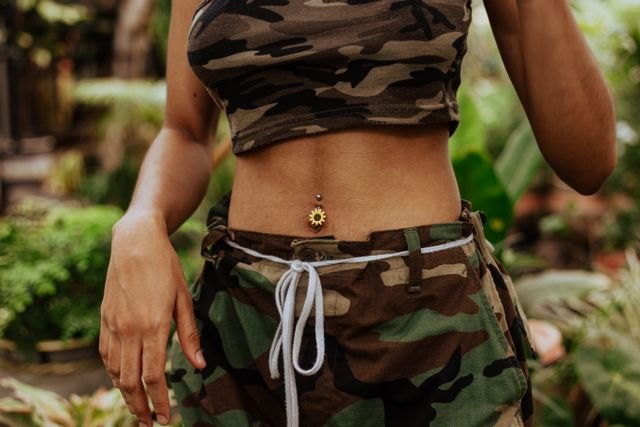
Floating navel piercing jewelry explained: find the right fit, material, style, and care for a comfortable heal.
Floating navel piercing jewelry is usually a curved barbell designed with a low-profile bottom end, such as a flat disc or small bead, so the jewelry can sit comfortably when the navel folds or compresses. The best piece depends on your anatomy, piercing placement, gauge, length, and healing stage, not simply the design you like most.
A floating navel piercing can look almost deceptively simple: a small gemstone or decorative end appears to hover above the belly button, while the lower part of the jewelry largely disappears from view.
That understated appearance is doing more work than you might think. The jewelry is designed around how the navel moves, particularly for anatomy where a traditional curved barbell with a prominent lower end creates pressure when sitting, bending, or wearing fitted clothing.
That makes choosing floating navel piercing jewelry less like buying an ordinary fashion accessory and more like choosing footwear. Two pieces can look nearly identical, yet one can fit beautifully while the other constantly rubs, catches, or presses into the skin.
The important questions are therefore not just “Which one looks cutest?” but “What will fit my anatomy, support healing, and remain comfortable in everyday life?”
What You'll Discover:
What Is Floating Navel Piercing Jewelry?
Floating navel jewelry is generally a curved barbell configured with a small or flat lower end and a decorative upper end. The lower component may sit inside the navel or against the surrounding tissue rather than creating the prominent dangling appearance associated with conventional belly-button jewelry.
The word “floating” describes the visual effect as much as the construction: the decorative top appears to float above the navel.
Professional piercers may use slightly different terminology and jewelry configurations, so there is no single universal “floating navel” design. What matters is how the jewelry interacts with the anatomy and the placement of the piercing.
A useful rule is simple: floating jewelry should reduce unnecessary pressure and movement rather than merely imitate a particular look.
Why Anatomy Matters More Than Jewelry Trends
Navel anatomy varies considerably. Some people have a pronounced upper fold or “shelf,” while others have a shallow navel, a less defined rim, or a navel that folds inward when they sit.
A traditional navel piercing can work beautifully when the anatomy provides enough stable tissue and space for the jewelry. But if a prominent bottom bead repeatedly presses into a folding navel, irritation can become a persistent problem.
A floating configuration can sometimes solve that mechanical issue by using a lower end that occupies less space.
This is also why body size is a poor shortcut for deciding whether someone is suited to a floating navel. The relevant question is the shape and behavior of the navel itself, not whether someone is thin, plus-size, muscular, or somewhere in between. Professional piercing studios emphasize anatomy assessment rather than body-weight rules.
A simple anatomy check
Look at your navel while standing and then while sitting normally.
If the shape changes dramatically, folds closed, or presses against jewelry, tell your piercer. A professional should assess the area in multiple positions rather than judging it only while you are standing.
Floating vs. Traditional Navel Jewelry
The biggest difference is the relationship between the jewelry and the navel when the body moves.
| Feature | Floating Navel Jewelry | Traditional Navel Jewelry |
| Lower end | Usually flat, small, or low-profile | Often a visible bead or gemstone |
| Visual effect | Decorative top appears to “float” | Jewelry is visible above and below |
| Useful for | Shallow, folding, or anatomy-specific placements | Navels with suitable defined tissue and space |
| Pressure management | Designed to minimize lower-end pressure | Depends heavily on jewelry shape and anatomy |
| Styling | Minimal, gemstone, bezel, decorative | Very broad range of decorative designs |
| Fit priority | Extremely important | Extremely important |
| Initial jewelry | Usually chosen conservatively | Usually chosen conservatively |
Neither style is automatically superior.
A traditional navel piercing may be the better option for one person, while floating jewelry may be the smarter configuration for another. The jewelry should follow the anatomy, not the other way around.
How to Choose the Right Floating Navel Jewelry
Start With the Material
For a healing piercing, material quality matters more than a bargain price.
The Association of Professional Piercers recommends body jewelry made from materials appropriate for fresh piercings and stresses that size, style, material, and manufacturing quality all affect healing. Implant-certified titanium is widely used for initial body jewelry, while suitable solid gold can also be appropriate when it meets professional standards. Gold-plated, gold-filled, and vermeil pieces are not appropriate substitutes for solid body-safe gold in a fresh piercing.
For a new piercing, ask the studio exactly what material is being used rather than relying on vague labels such as “hypoallergenic” or “surgical.”
Factual takeaway: Jewelry worn inside a fresh piercing should be selected for biocompatibility and fit first, appearance second.
Pay Attention to the Gauge
Gauge refers to the thickness of the jewelry shaft. A smaller gauge number means a thicker bar.
Many navel piercings use 14G jewelry, approximately 1.6 mm, but the correct gauge is determined by the actual piercing and the jewelry selected by your piercer. Do not assume that every floating navel requires the same gauge.
Buying a thinner bar simply because it looks more delicate can be a poor trade-off if it does not match the existing piercing.
Get the Length Right
Length is where online jewelry shopping gets particularly tricky.
A piece that is too short can create pressure, swelling, or embedding. One that is too long may move excessively, catch on clothing, and repeatedly traumatize the piercing. The Association of Professional Piercers specifically warns that poorly fitted jewelry can increase the risk of swelling, embedding, catching, and other complications.
For that reason, avoid choosing a floating navel bar solely from a generic size chart.
Your piercer can measure the wearable length needed for your anatomy, and that measurement may change after initial swelling subsides.
Choose the Bottom End Carefully
The defining feature of floating jewelry is often the bottom end.
A flat disc can provide a very low-profile contact point. A tiny bead may work for another anatomy. A larger decorative stone, meanwhile, can create pressure in a navel that folds when sitting.
The “smallest possible” bottom end isn’t automatically the best choice either. It still needs enough surface area and appropriate geometry for the piercing’s placement.
Think of it as a door hinge: the component does not need to be visually impressive, but it needs to perform its job without fighting the movement around it.
The Best Styles for a Floating Navel
Once the piercing is fully healed and the fit has been confirmed, there is much more room for personal style.
Minimalist Floating Jewelry
A tiny bezel-set stone or plain polished end gives the classic floating effect without adding much visual weight.
This is particularly useful if you prefer jewelry that works with everyday clothing rather than becoming the centerpiece of an outfit.
CZ and Gemstone Styles
Cubic zirconia can provide a diamond-like sparkle at a lower price, while genuine gemstones offer different colors and character.
For a healing piercing, however, stone size and setting matter. A complicated or protruding design can catch on clothing more easily, so elaborate jewelry is generally better treated as a later upgrade rather than the default starting piece.
Gold Floating Jewelry
Solid 14k or 18k gold can be an elegant choice once the material and alloy meet professional body-jewelry standards.
The important distinction is solid gold versus gold-colored coating. A gold-colored titanium piece and a gold-plated fashion piece are not equivalent products, and “gold tone” says nothing about whether jewelry is suitable for a healing piercing.
Threadless vs. Internally Threaded Designs
Both systems can be excellent when properly manufactured.
Threadless jewelry uses a precision-fit pin to secure the decorative end. Internally threaded jewelry screws the end into the bar from the inside, keeping the external portion smooth.
The mechanism itself is less important than manufacturing quality, secure attachment, appropriate sizing, and whether the jewelry is suitable for your piercing.
When Should You Change Floating Navel Jewelry?
This is one area where impatience causes unnecessary trouble.
A navel piercing can look healthy on the outside while the internal piercing channel is still healing. The Association of Professional Piercers notes that piercings heal from the outside inward, meaning apparent surface healing does not necessarily mean the entire channel is mature.
Navel healing can take many months and, for some people, a year or longer. Cleveland Clinic notes that belly-button piercings can take up to a year or more to fully heal, while public-health guidance gives shorter average ranges but acknowledges that healing varies between individuals.
If the initial jewelry needs downsizing because swelling has gone down, that is different from casually changing jewelry for fashion. Have a qualified piercer assess the fit and perform early jewelry changes.
A piercing can feel healed before it is actually healed.
How to Care for Floating Navel Jewelry
Good jewelry cannot compensate for aggressive aftercare.
The Association of Professional Piercers recommends sterile saline wound wash containing 0.9% sodium chloride and advises against rotating or twisting healing jewelry. It also recommends avoiding harsh products such as alcohol and hydrogen peroxide, unnecessary friction, and excessive pressure.
A practical routine looks like this:
- Wash your hands before touching the area.
- Rinse with appropriate sterile saline.
- Allow crust or buildup to soften rather than picking it off aggressively.
- Dry gently with a clean disposable product.
- Keep waistbands and clothing from repeatedly rubbing the jewelry.
- Avoid unnecessary touching, spinning, or repositioning.
- Don’t hang charms or heavy decorations from a healing piercing.
- Avoid swimming or soaking the healing piercing in pools, hot tubs, lakes, or similar water unless appropriately protected.
That last point matters more than it sounds. A navel is constantly affected by bending, sitting, clothing, and abdominal movement, so repeated mechanical irritation can be just as disruptive as poor cleaning.
How to Tell Irritation From a Possible Infection
Some tenderness, swelling, redness, itching, and light crusting can occur during normal healing.
The warning signs are different: worsening pain, increasing warmth or redness, significant swelling, thick or foul-smelling discharge, or feeling generally unwell can indicate infection and deserve medical evaluation. Healthdirect Australia and Mayo Clinic both advise seeking medical care when a piercing becomes increasingly painful or produces pus.
Don’t automatically assume every bump is an infection, either. Irritation, contact dermatitis, metal sensitivity, pressure, and migration can produce similar-looking symptoms. The APP’s troubleshooting guidance specifically notes that jewelry material and cleaning products can contribute to irritation.
If infection is suspected, don’t simply remove the jewelry yourself. Seek advice from a healthcare professional and a qualified piercer; removal can sometimes complicate drainage and closure of the piercing channel.
Common Mistakes When Buying Floating Navel Jewelry
Buying by Appearance Alone
A beautiful curved bar can still be the wrong length, gauge, curvature, or bottom-end shape.
Fit should come before sparkle.
Assuming One Size Fits Everyone
Navel anatomy is unusually individual. Even two people with similar-looking piercings may require different jewelry lengths.
Choosing Cheap Mystery Metal
A low price isn’t automatically a problem, but unclear material specifications are.
Look for precise material information and, for professional-grade jewelry, documentation supporting the stated metal standard.
Changing Jewelry Too Early
The jewelry may look ready to change weeks before the piercing actually is.
Let healing, not excitement, set the schedule.
Wearing Heavy Charms
Weight and movement create additional forces on a healing piercing. The APP specifically advises against hanging charms or objects from healing jewelry.
A Practical Buying Checklist
Before ordering floating navel piercing jewelry, check:
- Gauge: Does it match your piercing?
- Length: Has a piercer confirmed the required wearable length?
- Material: Is the metal clearly identified?
- Bottom end: Is it genuinely low-profile and suitable for your anatomy?
- Attachment: Is the decorative end securely made?
- Setting: Are stones securely held rather than loosely glued?
- Healing status: Is your piercing actually ready for a jewelry change?
- Lifestyle: Will the jewelry catch on clothing or interfere with your normal activities?
- Seller quality: Does the seller provide meaningful material and sizing information?
If you cannot answer several of these questions, the piece probably isn’t ready for your shopping cart yet.
Frequently Asked Questions
Is floating navel jewelry better than regular belly-button jewelry?
Not universally. Floating jewelry can be more suitable for navels that fold, collapse, or lack the anatomy needed for a conventional lower decorative end, but a professional assessment is the best way to determine which configuration fits.
What material is best for floating navel jewelry?
For a healing piercing, implant-certified titanium is a common professional choice. Certain solid gold alloys can also be appropriate when they meet recognized body-jewelry standards.
Can I wear floating navel jewelry in a new piercing?
The jewelry style can be used as part of an initial piercing when a qualified piercer selects an appropriate design, material, gauge, and fit. Decorative upgrades should not be confused with appropriate initial jewelry.
How long does a floating navel piercing take to heal?
Healing varies substantially. Expect a process measured in months rather than weeks, with some navel piercings taking a year or longer to fully mature.
Can I use a flat disc on any navel piercing?
No. A flat disc may be useful in a floating configuration, but the correct jewelry depends on the piercing’s placement, anatomy, curvature, and tissue behavior. A professional piercer should determine the fit.
Key Takeaways
- Floating navel piercing jewelry is primarily about fit and anatomy, not just appearance.
- A low-profile bottom end can reduce pressure for certain navel shapes, especially when the navel folds while sitting.
- Implant-certified titanium is a widely used option for healing piercings; suitable solid gold is another possibility when it meets professional standards.
- Gauge and length should match the existing piercing rather than being guessed from a generic chart.
- A piercing can appear healed externally while the internal channel is still fragile.
- Avoid twisting, harsh cleaning products, unnecessary friction, and heavy charms during healing.
- Persistent pain, worsening redness, warmth, swelling, pus, or systemic symptoms warrant medical attention.
Additional Resources
- Jewelry for Initial Piercings: A useful reference for understanding jewelry materials, gauge, sizing, construction, and why initial body jewelry requires higher standards than ordinary fashion jewelry.