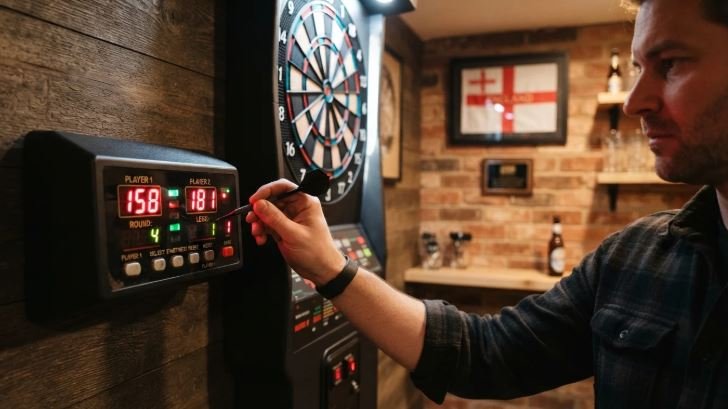
Electronic dart scorer myths debunked: learn what ‘electronic’ really means before buying and get the right scorer the first time.
Most disappointment with electronic dart scorers traces back to a handful of myths about what the word “electronic” actually means. The units themselves are simple, reliable tools, but ecommerce listings rarely explain them well, and buyers fill the gaps with assumptions. Clearing up those assumptions before buying costs nothing, and it gets the right unit on the wall the first time.
What You'll Discover:
The automatic scoring myth
The most common misunderstanding starts with the name. An electronic soft-tip dartboard has sensors inside every segment, so it detects where each dart lands and scores the visit on its own. A keypad scorer for a steel-tip bristle board works differently. It’s a manual-input device: a dedicated computer where a player keys in the score after each three-dart visit, and the unit handles everything from that point.
The confusion is understandable. Soft-tip machines in pubs and clubs score automatically, and product photos on ecommerce listings show a scorer mounted beside a board with no explanation of where the numbers come from. A buyer reasonably assumes the unit watches the darts, but on a keypad scorer entry happens at the keypad, one total per visit, and the scorer does the rest. Camera-based scoring systems for steel-tip boards are a separate type: they detect where each dart lands and score automatically.
What the scorer does is remove the arithmetic. It subtracts ’01 scores, tracks Cricket marks, applies the rules of the selected game, and keeps the rotation moving without a chalkboard or a mental tally. The payoff shows up in the pace of play. With a chalkboard, every visit ends in a pause while someone works out the remaining total, and close finishes turn into arithmetic debates. With a scorer, the next player is throwing within seconds.
The “every scorer has the same games” myth
Cheap generic units often ship with 301, 501, and one basic Cricket variant, and the software ends there. Better units program in Tactics, Killer, Count-Up, and multiple Cricket options, along with point-limit settings and double-in or double-out rules for the ’01 games. Cut-throat Cricket and point-limited variants are often missing from stripped-down software. A scorer with only three games gets replaced the first time someone suggests Tactics, while one with a deeper library stays useful through years of changing tastes.
Customization matters as much as quantity: adjustable point limits in Cricket and optional double-out finishes let the unit match the rules a local league actually plays.
Ecommerce listings make this comparison harder than it should be, because product photos all look alike. The game list appears in the specification section, and that’s where the real audit happens. A buyer who runs Killer on club night should count the programmed games before anything else.
The battery drain myth
Older backlit LCD screens gave electronic scoreboards a reputation for chewing through batteries, and the reputation has outlived the technology. Power consumption and battery life vary by model and display design. Auto-sleep functions stretch battery life across weeks of ordinary use, since the unit powers down between sessions. That shift matters most in rooms where the board sits far from an outlet.
Battery power is no longer the compromise it once was. Batteries make the unit portable and keep the wall free of cables, which suits a board that moves between rooms or travels to a holiday house. An AC adapter suits a permanent setup beside the board, where the unit never moves and never needs fresh batteries. Players who mount the scorer inside a cabinet, or take it to a friend’s garage, stop thinking about outlets altogether.
Touchpads, buttons, and stray darts
Build quality separates scorers more than any software feature, and the input method is where the difference shows first. Cheap touch-sensitive pads give no physical feedback, so players jab twice or stop the game to check whether a score registered. Tactile membrane switches resist under the finger and confirm each input by feel, which keeps score entry fast even when the player never looks at the unit. Over a long evening, that’s the difference between score entry that feels quick and score entry that feels clumsy.
The membrane surface wipes clean and seals the electronics underneath, and it tolerates the repeated pressing a scorer absorbs across years of league nights.
Home setups put the scorer within reach of bad throws, and a hard-cased unit with physical buttons survives impacts that would crack an exposed touch panel. When comparing build quality on ecommerce sites, players do well to browse dedicated darts scorers and check each listing for tactile buttons and an impact-resistant casing, because the occasional wild throw is a certainty in any home game room.
The solo play myth
Plenty of buyers scroll past the “play the computer” feature and assume it’s a toy for children. Virtual opponent modes on quality scorers simulate player averages across a range from beginner to professional level, so a solo session plays out like a genuine match. The computer’s visits follow realistic patterns: steady high scores at the upper levels, scrappy 40s and 60s at the lower ones.
The opponent’s level can usually be set before the match, so the challenge scales as a player’s own average improves. A beginner starts against a beatable opponent and steps the level up over months, which gives practice a progression that throwing at an empty board never provides. Chasing a simulated opponent with a believable average creates the same pressure as a league leg and builds finishing habits that aimless repetition doesn’t. For players without a regular practice partner, the feature changes what a home board is for. A solo match also fits into twenty spare minutes, which makes weeknight practice far easier to keep up.
The installation myth
Some players picture wiring and permanent wall damage. The actual job is a mounting bracket and a few screws. Most scorers hang flat beside the board or integrate into a dartboard cabinet, and battery-powered units skip cable routing altogether. An AC-powered unit needs one outlet within reach. Most units weigh little enough that standard wall fixings cope easily.
Cabinet integration solves two problems at once. A scorer mounted inside or beside a wooden cabinet sits at a natural height next to the board, and the cabinet doors close over the whole setup when the room needs to look like a living room again. Placement is worth a moment of thought: the screen should be readable from the throw line, and the keypad should sit within easy reach of whoever is scoring. The installation isn’t permanent, either. A scorer on a bracket moves house as easily as the dartboard does, which matters for renters and for anyone who rearranges the game room twice a year.
The cheapest listing pitfall
Mass ecommerce marketplaces carry pages of unbranded scorers at tempting prices, and the savings usually come from somewhere visible in daily use. Viewing angle is the classic failure. A cheap display washes out when read from the throw line, so players walk back to the board after every visit to confirm a score they should be able to read from where they stand. The photos rarely show the problem, because a dim display photographs perfectly well up close.
Support is the second failure. When a power adapter fails or a button stops responding, an unbranded seller may offer no replacement parts and no warranty process worth the name. User reviews help, though they reward reading past the star average, because complaints about dim displays and dead buttons cluster in the longer three-star reviews. Return windows on large marketplaces soften the risk, but a return still costs the evening spent repacking the unit and waiting for a replacement.
Read the specification table first and the photos second. Check what power supply ships in the box, whether the display type is named, and whether the seller answers pre-sale questions. A seller who can’t say which games are programmed into the unit has already told a buyer something. A recognized brand with spare adapters and a real support channel costs more up front and less across a few years of play.
The casual play myth
The last myth says these units suit family games and stop there. Advanced scorers handle handicap settings that adjust starting scores, so a strong league player and a complete beginner can compete on level terms. The mechanics vary by game: starting scores shift in ’01 games, and Cricket handicaps adjust marks. Once set, the unit applies the adjustment automatically, and neither player has to think about the math.
Leg and set tracking mirrors tournament formats, which matters for anyone whose local league runs matches across multiple legs. It also lets a household run a proper best-of match with a result that feels earned. For league players, practicing the same leg-and-set rhythm used on match night removes one more variable from competition. Built-in checkout tables suggest finishing combinations for the ’01 games, and they settle the debates that used to end with someone fetching a phone.
From family night to league preparation, everything runs on the same unit, and the software adapts to whoever is standing at the line.
Every myth on this list has the same fix, and it costs nothing. Read the specification section before the reviews. Check the game list, display type, button style, power options, and handicap features, and the right unit usually identifies itself within a few listings.