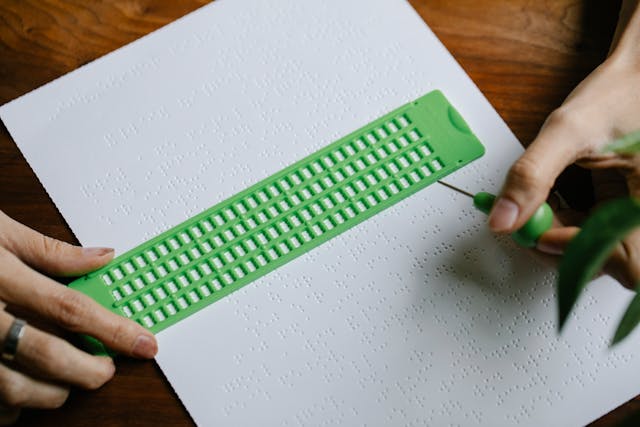
Who invented braille writing system? Discover the inspiring story of Louis Braille and how his dots opened a world of reading.
Louis Braille invented the braille writing system. He created it in the 1820s as a blind teenager in France, adapting a military “night writing” code into a readable dot system for blind readers.
The first time I saw braille up close, it didn’t look like language. It looked like tiny bumps on an elevator button, something functional, almost invisible to those who don’t need it.
Then someone asked me to close my eyes and try to read it with my fingers. I felt nothing but confusion. No letters. No words. Just texture.
That moment made me wonder: Who invented braille writing system, and how did they imagine reading without sight?
Because inventing braille isn’t just a story about dots. It’s a story about frustration, curiosity, and a stubborn belief that knowledge should not depend on eyesight. It’s about a child who lost his vision but refused to lose access to words.
And as I dug into the history, I realized this wasn’t a neat, linear tale. It was messy. Experimental. Human.
Let’s piece it together.
What You'll Discover:
The Simple Answer to “Who Invented Braille Writing System?”
The person who invented braille writing system was Louis Braille, a French educator and inventor born in 1809.
He lost his sight at a very young age and later developed a tactile reading and writing system based on patterns of raised dots.
A quotable fact: “Louis Braille published his first braille system in 1829 when he was just 20 years old.”
That line alone carries weight. Most of us are still figuring out our lives at 20. He was redesigning literacy.
But the deeper story is how he got there.
Louis Braille’s Childhood: Where the Journey Began
A Curious Child in a Workshop
Louis Braille grew up in Coupvray, a small town near Paris. His father was a harness maker, someone who worked with leather, tools, and sharp instruments.
As a child, Louis loved exploring his father’s workshop. It was a place of textures and smells: leather scraps, metal tools, polished wood.
One day, at age three, he tried to punch holes in leather using an awl. The tool slipped. It injured his eye.
Infections spread. By age five, he was completely blind.
That’s the clinical version.
The human version? A child who went from seeing the world to remembering it.
Education Without Sight: The Early Struggles
At that time, education for blind children was extremely limited. Books for the blind were rare and bulky. Letters were embossed in raised print, but they were slow to read.
Imagine tracing entire Roman letters with your finger. It’s like reading by touching sculptures.
A quotable fact: “Early tactile books for the blind were so large that a single book could fill a small suitcase.”
Reading wasn’t just hard, it was impractical.
Yet Louis Braille was bright. His family and teachers noticed. He earned a scholarship to the Royal Institute for Blind Youth in Paris.
That school would change everything.
The Unexpected Influence: Military Night Writing
The Code That Soldiers Used in the Dark
Here’s where the story gets interesting.
A French army captain named Charles Barbier created a system called “night writing.” Soldiers used it to communicate silently in the dark without speaking or lighting candles.
It used raised dots and dashes.
Sounds promising, right?
Not exactly. It was complicated. Too many dots. Too many sounds. Hard to learn. Soldiers didn’t love it.
But when Barbier presented it at Louis’s school, young Braille saw potential.
A Teenager’s Breakthrough
Louis Braille was around 12–15 years old when he started experimenting with Barbier’s system.
He simplified it. Drastically.
He reduced it to a six-dot cell. Two columns. Three dots each. Different combinations represented letters and punctuation.
Simple. Logical. Compact.
A quotable fact: “The modern braille cell contains six dots, allowing 64 possible combinations.”
That mathematical elegance made braille powerful.
It wasn’t just readable. It was writable. Blind people could write independently for the first time.
Think about that shift. From being read to, to becoming a reader and writer.
Why Braille Was Revolutionary
Independence, Not Just Literacy
Braille didn’t just help people read books. It allowed:
- Personal notes
- Letters
- Music notation
- Mathematics
- Academic study
Before braille, blind individuals often relied on others to access written knowledge.
After braille, they could explore ideas privately.
And privacy matters. It’s the difference between hearing a story and owning it.
Resistance and Skepticism
You might assume everyone celebrated braille immediately.
They didn’t.
Many sighted educators preferred raised print letters because they could read them too. Braille looked alien to them.
There’s a quiet irony here: A system designed for blind readers was judged by sighted comfort.
Louis Braille himself never saw full global acceptance of his system during his lifetime. He died in 1852.
Braille became widely adopted only years later.
Progress can be slow. Even when it’s brilliant.
How Braille Spread Across the World
Once adopted in France, braille gradually spread to:
- Europe
- North America
- Asia
- The rest of the world
Different languages adapted braille to their alphabets. Today, there are braille systems for Arabic, Chinese, Hindi, and many more.
Music braille and math braille (Nemeth Code) expanded its use further.
Braille became not just a tool, but a global literacy bridge.
How Braille Actually Works
The Six-Dot Cell
Each braille character fits into a small rectangle called a cell.
Dots are numbered:
1 4 2 5 3 6
Different dot combinations represent letters.
For example:
- A = dot 1
- B = dots 1 and 2
- C = dots 1 and 4
It’s binary-like in its logic. Minimal yet expressive.
Braille in the Digital Age
You might wonder: with audio tech and screen readers, is braille still relevant?
Yes. Deeply.
Audio gives access. Braille gives literacy.
Spelling, punctuation, formatting, these are fully grasped through braille.
Refreshable braille displays now connect to computers and phones, turning digital text into tactile dots.
Braille evolved with technology instead of being replaced by it.
Comparative Snapshot: Key Figures & Systems
| Figure/System | Contribution | Limitation | Impact |
|---|---|---|---|
| Charles Barbier | Night writing code | Too complex | Inspired braille |
| Louis Braille | Six-dot braille system | Slow acceptance | Global literacy |
| Raised Print Systems | Tactile Roman letters | Bulky & slow | Early stepping stone |
This comparison shows something subtle: Innovation is often a chain, not a single spark.
The Human Side of Louis Braille
Louis Braille wasn’t a celebrity inventor. He was quiet. Studious. Musical. He became a teacher at his own school.
He reportedly loved music and played the organ.
I imagine him testing dot patterns late at night, fingers moving over paper, chasing clarity.
Not for fame. For function.
That humility makes his legacy feel even bigger.
Why This Story Still Matters
Because access to information is power.
Because inclusive design benefits society.
Because a teenager solved a problem adults couldn’t.
And because literacy is a human right, not a privilege.
When we ask who invented braille writing system, we’re really asking: Who believed blind people deserved full access to knowledge?
Louis Braille did.
FAQ
Who invented braille writing system?
Louis Braille, a French educator who became blind as a child, invented it in the 1820s.
When was braille invented?
The first braille system was published in 1829.
Was braille based on another system?
Yes. It was inspired by Charles Barbier’s military night writing code.
Is braille still used today?
Yes. It’s widely used worldwide and integrated into digital devices.
How many dots are in a braille cell?
A standard braille cell contains six dots.
Key Takings
- Louis Braille invented the braille writing system as a blind teenager.
- His system was inspired by a military code but simplified for reading.
- Braille enabled independent literacy for blind individuals.
- It was not widely accepted during Braille’s lifetime.
- Modern technology still relies on braille displays.
- Braille supports music, math, and multiple languages.
- The invention proves accessibility can change history.