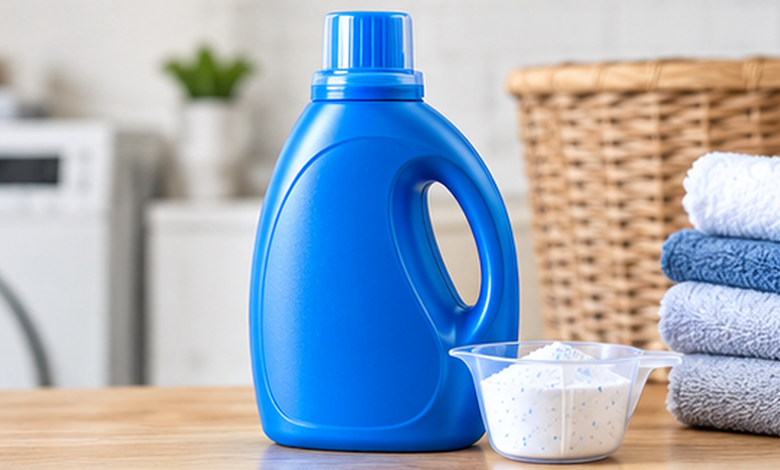
Learn to pronounce laundry detergent naturally in UK and US English, with easy syllables, IPA, examples, and common mistakes.
Laundry detergent is pronounced “LAWN-dree dih-TUR-juhnt” in a simple English approximation. Cambridge gives the UK pronunciation as /ˈlɔːn.dri dɪˌtɜː.dʒənt/ and the US pronunciation as /ˈlɑːn.dri dɪˌtɝː.dʒənt/.
The main difference is the vowel in laundry and the r-colored vowel in the American pronunciation of detergent.
What You'll Discover:
Why “laundry detergent” Can Feel Difficult to Pronounce
At first glance, laundry detergent looks straightforward. Then you try to say it quickly and suddenly two ordinary words seem determined to trip over each other.
The difficulty comes from the combination of sounds rather than from either word alone. Laundry has a reduced middle sound in natural speech, while detergent contains the less familiar /dʒ/ sound, the same sound heard at the beginning of job or jump. Cambridge lists three syllables for detergent and shows the stress on the middle syllable.
A useful way to approach the phrase is to learn it in pieces:
laundry + detergent → LAWN-dree + dih-TUR-juhnt
Once those pieces are comfortable, connecting them becomes much easier.
How to Pronounce Laundry Detergent
The easiest pronunciation guide
For an English learner, this approximation is practical:
UK: “LAWN-dree dih-TUR-juhnt”
US: “LAHN-dree dih-TUR-juhnt”
The first word carries the main stress: LAWN-dree. The second word has its strongest stress around TUR: dih-TUR-juhnt.
Cambridge’s UK IPA is /ˈlɔːn.dri dɪˌtɜː.dʒənt/, while its US IPA is /ˈlɑːn.dri dɪˌtɝː.dʒənt/.
IPA is precise, but you do not need to memorize it to speak naturally.
Break it into syllables
Try this progression:
LAWN — dree — dih — TUR — juhnt
Now connect the first two:
LAWN-dree
Then the last three:
dih-TUR-juhnt
Finally:
LAWN-dree dih-TUR-juhnt
Start slowly. Natural speed comes later.
How to Pronounce “Laundry”
The first word is often the part learners overcomplicate.
Cambridge gives laundry as /ˈlɔːn.dri/ in British English and /ˈlɑːn.dri/ in American English.
The important point is that laundry is not normally pronounced as though every written letter gets its own clear sound. The word effectively settles into two syllables:
LAWN-dree or LAHN-dree
Think of it as two connected beats rather than something like “law-un-dree.”
For example:
- laundry basket → “LAWN-dree basket”
- laundry room → “LAWN-dree room”
- do the laundry → “do the LAWN-dree”
Oxford lists laundry as /ˈlɔːndri/ and defines it as clothes or other items that need washing, are being washed, or have recently been washed.
How to Pronounce “Detergent”
Detergent is where many learners hesitate.
Cambridge gives the UK form as /dɪˈtɜː.dʒənt/ and the US form as /dɪˈtɝː.dʒənt/.
A useful learner-friendly version is:
dih-TUR-juhnt
Notice the stress:
dih-TUR-juhnt
Not:
DEE-ter-jent
And not:
dih-ter-GENT
The g in detergent represents the /dʒ/ sound, like the sound at the beginning of job, jungle, and January.
Oxford likewise gives detergent as /dɪˈtɜːdʒənt/ in its British entry and defines it as a liquid or powder used to help remove dirt, including from clothes and dishes.
UK vs US Pronunciation
There is no need to treat one accent as the “correct” version. Both are established English pronunciations.
| Part | UK English | US English |
| Laundry | /ˈlɔːn.dri/ | /ˈlɑːn.dri/ |
| Detergent | /dɪˌtɜː.dʒənt/ | /dɪˌtɝː.dʒənt/ |
| Easy approximation | LAWN-dree dih-TUR-juhnt | LAHN-dree dih-TUR-juhnt |
| Main noticeable difference | “or”-like vowel in laundry | More open “ah” sound in laundry |
| detergent middle vowel | British /ɜː/ | American /ɝː/ |
Cambridge specifically records both pronunciations, so hearing different versions does not mean one speaker is mispronouncing the phrase.
The accent can change the vowel, but the word remains recognizable.
How to Say It Naturally in a Sentence
Knowing the dictionary pronunciation is useful, but conversation is where pronunciation really matters.
Try these sentences:
“I need to buy laundry detergent.”
Say it slowly:
I need to buy / LAWN-dree / dih-TUR-juhnt.
Then make it more conversational:
“I need to buy laundry detergent.”
Another example:
“Which laundry detergent do you use?”
Or:
“We’re out of laundry detergent.”
The goal is not to pronounce every syllable with equal force. English speech naturally varies in stress, rhythm, and timing.
Practice with a short sentence
Use this three-stage exercise:
- Word by word: “laundry — detergent”
- Phrase: “laundry detergent”
- Sentence: “I need some laundry detergent.”
Repeat each stage several times.
If your pronunciation sounds slightly different from a dictionary recording because of your accent, that is perfectly normal. Clear communication matters more than imitating every tiny feature of another speaker’s accent.
Common Pronunciation Mistakes
Saying “laundry” too slowly
A common mistake is trying to pronounce the spelling letter by letter.
Instead of stretching the word into several obvious sounds, aim for the compact LAWN-dree / LAHN-dree pattern.
Stressing the wrong part of “detergent”
The middle syllable deserves the strongest emphasis:
dih-TUR-juhnt
Putting heavy stress on the beginning or ending can make the word sound less natural.
Turning “gent” into “gentle”
The ending -gent in detergent does not sound like the beginning of gentle.
The final portion is closer to:
juhnt
That weak vowel is important. English often reduces unstressed vowels, which is why the final syllable is not a strong “jent” sound.
Pronouncing every vowel too clearly
This is a subtle issue. Learners sometimes produce each vowel with the same strength because they are concentrating on accuracy.
Native speech usually does the opposite: stressed syllables stand out while unstressed syllables become lighter.
That is why dih-TUR-juhnt is more useful as a speaking guide than an exaggerated pronunciation of every letter.
“Laundry Detergent” vs “Washing Powder”
The phrase itself also changes depending on where you use English.
Cambridge identifies laundry detergent as a US term and notes washing powder/liquid as UK equivalents.
Collins similarly lists washing powder as a British expression and gives laundry detergent as the American English equivalent.
This matters when learning vocabulary because pronunciation and word choice are connected.
| Meaning | Common US expression | Common UK expression |
| Product for washing clothes | laundry detergent | washing powder / washing liquid |
| Powder form | powdered detergent | washing powder |
| Liquid form | liquid laundry detergent | washing liquid |
There is plenty of overlap, though. A British speaker will understand laundry detergent, and an American speaker will generally understand washing powder from context.
What Does “Laundry Detergent” Mean?
Laundry detergent is a cleaning product used to wash clothes and other fabric items.
Cambridge defines it as a detergent in powder or liquid form used for washing clothes and other cloth items.
The phrase is simply a combination of two words:
laundry = clothes or other fabric items being washed
detergent = a substance that helps remove dirt
That makes the phrase fairly transparent once you know the individual words.
For example:
“I put the laundry detergent in the washing machine.”
Here, laundry detergent identifies the type of detergent rather than dishwashing detergent or another cleaning product.
How to Practice the Pronunciation
You can improve this phrase without spending an hour memorizing phonetic symbols.
Use the “slow, connect, natural” method
Step 1: Slow
Say:
LAWN — dree — dih — TUR — juhnt
Step 2: Connect
Say:
LAWN-dree dih-TUR-juhnt
Step 3: Put it into speech
Say:
“I need laundry detergent.”
Step 4: Record yourself
Listen for two things: whether LAWN-dree remains clear and whether the main stress in detergent falls on the middle syllable.
This method works because you are practicing the actual transition from careful pronunciation to conversational speech, rather than memorizing an isolated transcription.
A Simple Accent Guide for English Learners
If IPA looks intimidating, remember just three ideas:
- laundry → think LAWN-dree / LAHN-dree
- detergent → think dih-TUR-juhnt
- laundry detergent → connect them smoothly rather than stressing every syllable
You do not need to sound British or American to pronounce the phrase correctly.
A learner with a Pakistani, Indian, Arabic, Spanish, Chinese, or other first-language accent may naturally produce slightly different vowel qualities. That is not automatically a pronunciation error; intelligibility and consistent stress are often more useful goals than eliminating every trace of an accent.
Frequently Asked Questions
How do you pronounce laundry detergent?
Say “LAWN-dree dih-TUR-juhnt” as a simple learner-friendly approximation. Cambridge gives the precise IPA as /ˈlɔːn.dri dɪˌtɜː.dʒənt/ in UK English and /ˈlɑːn.dri dɪˌtɝː.dʒənt/ in US English.
Is “laundry detergent” pronounced differently in British and American English?
Yes. The main differences are vowel sounds, especially in laundry and the middle of detergent. Both pronunciations are standard for their respective varieties of English.
Is it “detergent” or “detergent”?
The spelling is detergent. Its pronunciation begins approximately dih-TUR-, followed by a j sound: dih-TUR-juhnt. Cambridge and Oxford both place the main stress on the middle portion of the word.
What is “laundry detergent” called in British English?
British English commonly uses washing powder for powdered detergent and washing liquid for liquid detergent. Laundry detergent is also understandable in British English.
How many syllables are in “laundry detergent”?
In the standard Cambridge pronunciations, laundry has two syllables and detergent has three, giving five syllables altogether: LAWN-dree dih-TUR-juhnt.
Key Takeaways
- Laundry detergent is commonly pronounced “LAWN-dree dih-TUR-juhnt.”
- Cambridge gives separate UK and US IPA pronunciations, mainly differing in vowel sounds.
- Laundry is typically two syllables: LAWN-dree or LAHN-dree.
- Detergent is three syllables, with the main stress on the middle syllable: dih-TUR-juhnt.
- The /dʒ/ sound in detergent is like the j sound in job.
- British English commonly uses washing powder and washing liquid, while American English commonly uses laundry detergent.
- Clear, natural rhythm matters more than forcing yourself to imitate a particular accent.
Additional Resources
- Cambridge Dictionary pronunciation guide: Provides UK and US IPA, sound-by-sound guidance, and audio pronunciation for the complete phrase.