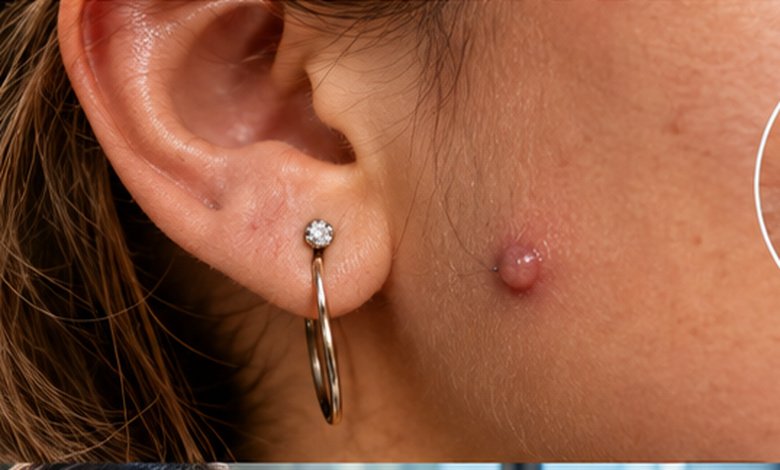
Keloid vs piercing bump? Learn the key differences, warning signs, causes, and what to do before the problem gets worse.
A piercing bump is usually a localized irritation, inflammation, or healing problem around the piercing, while a keloid is an abnormal scar that grows beyond the original wound. A bump that keeps enlarging, becomes firm, or extends beyond the piercing area deserves assessment by a dermatologist rather than home treatment alone.
What You'll Discover:
Why a Piercing Bump Is Not Automatically a Keloid
You notice a small lump beside your piercing and suddenly the question becomes: Did I get a keloid?
Not necessarily. “Piercing bump” is a broad, informal term that can describe several things, including irritation, inflammation, a granuloma, an allergic reaction, infection, or sometimes a raised scar. Keloids are a specific type of abnormal scar, and their behavior is different from most ordinary piercing bumps.
The distinction matters because the response can be completely different. An irritated piercing may improve when friction, pressure, jewelry problems, or harsh cleaning are corrected, whereas a true keloid generally does not simply disappear when you change your aftercare.
A keloid grows beyond the boundaries of the original wound. A hypertrophic scar remains within those boundaries.
That boundary is one of the most useful clues when trying to understand what you are seeing.
Keloid vs Piercing Bump: The Key Differences
| Feature | Piercing bump | Keloid |
| Typical cause | Irritation, trauma, pressure, jewelry or healing problems | Abnormal scar formation and genetic susceptibility |
| Location | Usually immediately around the piercing | Can extend beyond the original piercing wound |
| Growth | May fluctuate or shrink | Often progressively enlarges |
| Texture | May be soft, swollen, crusty or moderately firm | Often firm, rubbery or hard |
| Timing | Often appears during the healing period | May develop months or longer after injury |
| Borders | Usually localized around the piercing | Extends beyond the original wound |
| Symptoms | Irritation, tenderness, crusting or swelling are possible | Itching, tenderness or pain may occur |
| Natural course | May improve after irritation is removed | Usually does not disappear on its own |
| Treatment | Correct the source of irritation and use appropriate aftercare | Often requires professional scar treatment |
There is an important wrinkle: not every raised scar is a keloid. Hypertrophic scars can also become raised after an injury, but unlike keloids, they remain within the original wound area and may flatten over time.
That is why judging the bump by size alone can be misleading.
What Does a Piercing Bump Look Like?
A typical irritation bump tends to stay close to the piercing channel. It may appear red, pink, swollen, irritated, crusty, or slightly raised, particularly when the piercing is repeatedly disturbed.
Think about what the piercing experiences every day. A cartilage piercing can be pressed against a pillow at night, caught by hair, bumped by headphones, or snagged while changing clothes. Each small episode may seem insignificant, but repeated mechanical irritation can keep the healing process going.
Jewelry can also play a role. A piece that is too tight, too heavy, poorly fitted, or made from a material that irritates the skin can contribute to ongoing inflammation.
The Association of Professional Piercers specifically emphasizes reducing physical trauma and avoiding unnecessary manipulation during healing. Sleeping directly on a healing cartilage piercing, for example, can cause irritation and even contribute to changes in the piercing’s angle.
This is why a small bump should prompt a second question: “What keeps irritating this piercing?”, rather than immediately, “How do I remove this keloid?”
What Does a Keloid Look Like?
A keloid is different because the scar tissue continues growing beyond the area of the original injury.
It may feel firm, smooth, rubbery, or hard. Keloids can be skin-colored, pink, red, purple, brown, or darker than the surrounding skin, depending partly on the individual and the stage of the scar.
They commonly occur on areas such as the earlobes, ears, chest, shoulders, upper back, neck, and jawline. Piercings, particularly ear piercings, are a recognized trigger because they deliberately create an injury in the skin.
Timing can provide another clue. Keloids may take months to become apparent and can continue enlarging over a long period. The American Academy of Dermatology notes that the first sign after an injury can be skin thickening, while the NHS describes keloids as scars that can grow for months or years.
A keloid may itch or hurt while it is growing, although symptoms vary considerably.
Keloid vs Hypertrophic Scar: The Difference People Often Miss
This is where the terminology gets confusing.
A hypertrophic scar is raised scar tissue that stays within the boundaries of the original injury. It can become red, thick, itchy, or uncomfortable, particularly during earlier stages of healing, and it may gradually flatten or become less noticeable.
A keloid, by contrast, extends beyond the original wound.
That sounds simple, but real skin does not always behave like a textbook diagram. Dermatology literature notes that distinguishing abnormal scars can sometimes be difficult clinically, particularly when lesions have overlapping features.
So if a bump is clearly raised but you cannot tell where the original piercing injury ended, don’t rely on a photograph or a social-media comparison to diagnose yourself. A dermatologist can examine its growth pattern, location, texture, and history.
The most useful visual clue is not simply how big the bump is, it is whether the scar is growing beyond the original injury.
How Timing Can Help You Tell Them Apart
Timing is useful, but it should never be treated as a diagnosis by itself.
An irritation bump may appear relatively early while a piercing is still healing. It can flare after snagging, pressure, jewelry changes, or excessive cleaning and then settle when the source of irritation is addressed.
Hypertrophic scars also tend to appear relatively soon after injury and may eventually stabilize or regress.
Keloids can take considerably longer to become obvious. The American Academy of Dermatology notes that signs may first appear three to 12 months or longer after skin injury.
So imagine two scenarios.
Scenario one: You get a cartilage piercing. A few weeks later, you repeatedly sleep on it, and a small red bump develops directly beside the hole. That pattern is compatible with irritation.
Scenario two: Months after the piercing, a firm lump continues enlarging and begins extending well beyond the original piercing site. That pattern is much more concerning for a keloid and warrants professional evaluation.
Could It Be an Infection Instead?
This is an important third possibility.
A piercing bump is not synonymous with infection, and a keloid is not an infection. However, infection can also cause swelling around a piercing and needs different management.
Watch for increasing redness, warmth, swelling, tenderness, or drainage of pus. Fever or feeling generally unwell is another reason to seek medical attention.
Cartilage infections deserve particular caution because cartilage has a poorer blood supply than the earlobe, and infections in the upper ear can sometimes become serious.
A little irritation during normal healing is not automatically an infection. What matters is the overall pattern and whether symptoms are worsening rather than settling.
What Should You Do About a Piercing Bump?
If the bump appears related to irritation and there are no signs of significant infection, start by removing the sources of unnecessary trauma.
Wash your hands before touching the piercing. Avoid twisting, picking, squeezing, or repeatedly checking the bump. Review whether you are sleeping on it, catching it on clothing, hitting it with headphones, or using jewelry that does not fit properly.
Gentle cleansing is preferable to aggressive cleaning. The American Academy of Dermatology advises against hydrogen peroxide and antibacterial soaps for new piercings because they can damage healing skin.
There is also a surprisingly common mistake: trying to “burn out” the bump with harsh products.
Alcohol, hydrogen peroxide, undiluted essential oils, abrasive scrubs, and repeated chemical treatments can irritate healing tissue further. More cleaning is not necessarily better healing.
If the piercing is persistently swollen, painful, draining, or not improving, get it evaluated rather than experimenting with increasingly aggressive home remedies.
What If It Really Is a Keloid?
Do not try to cut, burn, puncture, or squeeze a suspected keloid yourself.
Keloids are difficult scars to treat, and simply removing the visible tissue does not necessarily solve the underlying problem. In fact, the American Academy of Dermatology notes that keloids can return after treatment, including after surgical removal.
Dermatologists may use treatments such as corticosteroid injections, pressure therapy, silicone products, cryotherapy, laser treatment, or combinations of these approaches depending on the individual lesion.
For some people, early intervention is particularly important because a newly thickening area may be easier to manage before it becomes a larger established scar.
If you have previously developed a keloid, tell your dermatologist before undergoing another piercing or procedure that injures the skin. A personal or family history of keloids can be relevant when considering future skin trauma.
When Should You See a Dermatologist?
Consider professional evaluation if:
- The bump continues getting larger.
- It extends beyond the original piercing area.
- It becomes increasingly firm or hard.
- It persists despite removing obvious sources of irritation.
- You have previously developed keloids.
- You are unsure whether the lesion is a keloid, hypertrophic scar, irritation bump, or something else.
- There is significant pain, warmth, spreading redness, pus, or fever.
The goal is not merely to put a label on the bump. It is to identify what is actually happening before you make it worse with unnecessary treatment.
A Simple Decision Guide
Start with the growth pattern.
If the bump is small and remains immediately around the piercing, irritation is one possibility. Look for mechanical triggers such as sleeping pressure, snagging, jewelry movement, or repeated touching.
If it is raised but stays within the original wound and eventually stabilizes, a hypertrophic scar may be involved.
If it progressively grows outward beyond the original wound, particularly over months, a keloid becomes more concerning.
If the area is hot, increasingly painful, significantly swollen, or producing pus, or you develop fever, think about infection and seek medical advice.
And if you simply cannot tell, that is a perfectly reasonable reason to have it examined. Skin conditions often overlap in appearance, and a professional assessment is more reliable than trying to diagnose a bump from a single photograph.
Frequently Asked Questions
Is every piercing bump a keloid?
No. A piercing bump can result from irritation, inflammation, an allergic reaction, infection, granuloma, or abnormal scarring. A keloid is specifically an abnormal scar that grows beyond the original wound.
How do I know if my piercing bump is becoming a keloid?
Progressive growth beyond the original piercing area is one of the strongest clues. A firm bump that continues enlarging over months should be evaluated by a dermatologist rather than assumed to be an ordinary irritation bump.
Can a piercing bump go away on its own?
Some irritation-related bumps can improve when the source of irritation is removed and the piercing is allowed to heal properly. Persistent or worsening bumps should be professionally assessed because several different conditions can look similar.
Do keloids go away naturally?
True keloids generally do not disappear on their own. Treatments can reduce their size and symptoms, but recurrence is possible, so management is often individualized.
Should I pop a piercing bump?
No. Squeezing or puncturing a bump can further injure the tissue, introduce bacteria, and prolong inflammation. A suspected keloid should never be cut or punctured at home.
Key Takeaways
- Keloid vs piercing bump is not simply a matter of size: the growth pattern and cause matter more.
- A keloid grows beyond the original wound, while a hypertrophic scar stays within it.
- An ordinary piercing bump is often associated with irritation, friction, pressure, jewelry problems, or healing complications.
- Increasing warmth, pain, swelling, pus, spreading redness, or fever can point toward infection rather than a simple scar.
- Do not squeeze, cut, burn, or aggressively treat a suspected keloid at home.
- A bump that keeps enlarging or spreads beyond the piercing site deserves assessment by a dermatologist.
- If you have developed keloids before, mention that history before getting another piercing or procedure that injures the skin.
Additional Resources
- Aftercare: A detailed guide to reducing friction, trauma, contamination, and other common problems while a new piercing heals.