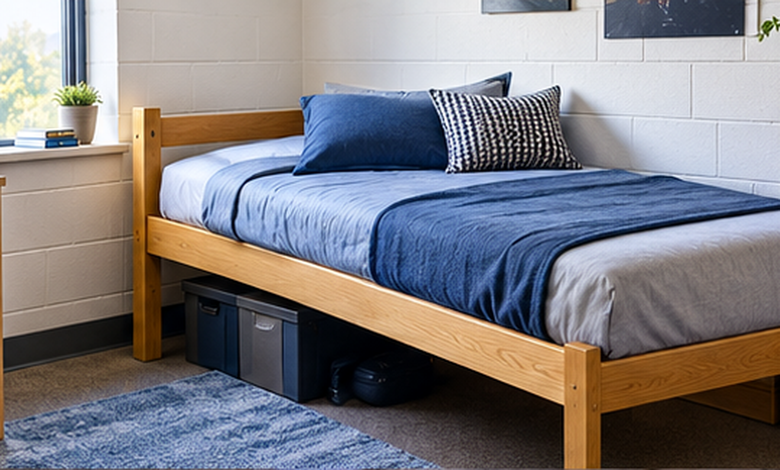
A dorm bed extender can transform a cramped Twin XL. Learn which type fits, what to buy, and what to check first.
A dorm bed extender usually makes a standard Twin XL dorm bed wider, most commonly converting its 38-by-80-inch sleeping area into a Full XL measuring about 54 by 80 inches. Some extenders widen the frame for a new mattress, while others add usable sleeping width around the existing Twin XL mattress.
Before buying one, check your university’s housing rules and the exact dimensions of your bed. Colleges differ widely: some permit approved bed risers or adjustable frames, while others prohibit retail modifications altogether.
What You'll Discover:
Why a Dorm Bed Extender Is Worth Considering
The standard college bed is designed around space efficiency, not luxury. A Twin XL mattress is typically 38 inches wide and 80 inches long, giving you the same length as a queen but 22 fewer inches of width.
That difference becomes surprisingly noticeable when your bed doubles as your reading chair, study spot, movie-watching station and occasional place to eat dinner.
A dorm bed extender addresses the width problem without necessarily replacing the entire university bed frame. Depending on the design, it can give you a substantially wider sleeping surface while keeping the original 80-inch length.
The important distinction is that “bed extender” can mean two different things. One type widens the frame and requires a larger mattress; another adds width to the sleeping surface while allowing you to keep the university-provided mattress.
Understanding that difference before shopping can save you from buying an expensive piece of equipment that doesn’t fit your room, or your housing rules.
What Is a Dorm Bed Extender?
A dorm bed extender is an accessory or conversion system designed to increase the usable width of a college dorm bed.
The most common starting point is a Twin XL bed. A frame-conversion system can extend it to approximately Full XL dimensions, while other products create an intermediate-width sleeping surface without replacing the mattress. Current products on the market demonstrate both approaches.
Twin XL vs. Full vs. Full XL
This is where many shoppers get tripped up.
| Mattress size | Typical width | Typical length | Dorm relevance |
| Twin | 38 in | 75 in | Usually too short |
| Twin XL | 38 in | 80 in | Common dorm size |
| Full | 54 in | 75 in | Wider but too short |
| Full XL | 54 in | 80 in | Common conversion target |
| Queen | 60 in | 80 in | Wider alternative |
The crucial measurement is the 80-inch length. A standard Full mattress is five inches shorter than a Twin XL, while Full XL keeps the 80-inch length.
A Full XL conversion needs a Full XL mattress if the extender creates a 54-by-80-inch frame. A regular Full mattress is not an equivalent substitute.
That five-inch difference might sound trivial on paper. On an unsupported frame, however, it can become a very obvious gap.
The Two Main Types of Dorm Bed Extenders
Not every extender solves the problem in the same way.
Frame extenders
A frame extender expands the supporting structure of the bed, usually from Twin XL toward Full XL width.
You then place a Full XL mattress on the enlarged support. Some commercially available systems attach to an existing college bed with straps and add slats or another supporting surface.
This approach gives you the most conventional result: a genuinely wider mattress with edge-to-edge sleeping space.
The trade-off is logistics. You now need a Full XL mattress, appropriate bedding and somewhere to store or otherwise handle the university’s original mattress if housing rules require it to remain in the room.
Mattress or sleeping-surface extenders
The second approach works differently.
Instead of replacing the Twin XL mattress, the extender adds material beside it or creates additional usable width around it. Current products include systems designed to retain the supplied mattress while increasing the sleeping surface.
This can be particularly attractive in a dorm because storage is precious. Keeping the original mattress means you aren’t trying to find a place for a bulky university mattress.
The compromise is that the result isn’t necessarily identical to sleeping on one conventional Full XL mattress. The construction of the join, the support underneath it and the firmness of the added section matter.
Which Dorm Bed Extender Should You Choose?
The right choice depends less on the advertised size and more on what you are actually trying to accomplish.
| Your priority | Better approach to investigate | Why |
| Maximum sleeping width | Full XL frame conversion | Creates a true 54-inch-wide mattress setup |
| Keep the university mattress | Mattress/surface extender | Avoids storing the supplied mattress |
| Simplest move-out | Non-permanent, compact system | Easier to remove and transport |
| Better long-term mattress choice | Frame conversion | Lets you choose your own Full XL mattress |
| Small room | Intermediate-width extender | Uses less floor space than a full conversion |
| Extra under-bed storage | Bed risers or approved lofting | Solves vertical space rather than mattress width |
There is an easy mistake here: assuming a bigger bed automatically makes a better dorm room.
It doesn’t.
A Full XL bed adds roughly 16 inches of width compared with a Twin XL. That extra sleeping space is excellent if you spend hours on your bed, but it also consumes floor area that could otherwise hold a chair, storage unit or open walking space.
Check Your University’s Rules Before Buying
This is the step worth doing before spending money.
Universities don’t follow one universal policy for dorm beds. At Clemson, for example, students can adjust university-provided modular beds but are not allowed to use personal bed risers or constructed lofts.
At the other end of the spectrum, the University of Texas at Dallas permits bed risers under certain conditions, including a prohibition on fastening them to the bed with tools or adhesives.
Other schools are stricter. Johns Hopkins says retail-purchased bed risers are not permitted in its university residences, while the University of Arkansas prohibits residents from constructing their own lofts and specifies approved equipment for elevated configurations.
The lesson is simple:
“Dorm-approved” is not the same thing as “approved at my university.”
What to look for in your housing policy
Search your housing handbook for terms such as:
- Bed modifications
- Furniture modifications
- Bed risers
- Lofting
- Bunking
- Mattress dimensions
- University-provided furniture
- Approved accessories
- Room alterations
Also check whether the policy applies to all dorms or only specific buildings. The University of South Carolina, for instance, has different loft and riser rules depending on the residence hall.
Measure the Bed, Not Just the Mattress
A surprisingly common mistake is buying an extender based solely on “Twin XL.”
Dorm furniture isn’t perfectly standardized.
The University of New Hampshire, for example, lists Twin XL beds with 11 to 14 inches of clearance underneath without risers, while the University of Iowa lists a Twin XL mattress at 38 by 80 inches and a bed frame measuring 40 inches wide.
Another university may use a 36-inch-wide mattress or a different frame construction.
Before ordering, measure:
- Mattress width
- Mattress length
- Frame width
- Frame length
- Leg or rail configuration
- Distance from the floor
- Available clearance around the bed
- Mattress thickness
Take photographs of the frame as well, particularly if the extender attaches to specific rails or legs.
A product that fits a generic 38-inch Twin XL mattress isn’t automatically compatible with every university bed frame.
Don’t Forget the Mattress Support
Width alone doesn’t make a good bed.
Imagine putting a 54-inch mattress on a structure that was originally designed around a 38-inch mattress. If the outer portion isn’t properly supported, the mattress can flex differently at the edges, and the sleeping surface may feel uneven.
This is why frame construction matters more than a simple “adds 16 inches” marketing claim.
Look for information about slats, support rails, attachment points, weight capacity and the transition between the original frame and extension. A Full XL conversion that provides continuous support is fundamentally different from one that leaves a large unsupported span.
What Bedding Do You Need?
If your conversion creates a true Full XL bed, Full XL bedding is the straightforward choice.
Full XL is 54 by 80 inches, matching the converted mattress dimensions used by many dorm-bed conversion systems.
Queen bedding can sometimes be used because a queen is also 80 inches long, although it is six inches wider. That extra fabric can be tucked under in some setups, but it isn’t the same as having precisely fitted Full XL bedding.
Don’t buy ordinary Full sheets simply because the package says “Full.”
A Full mattress is 54 by 75 inches, so the five-inch length difference remains.
When a Dorm Bed Extender Is the Wrong Solution
Sometimes the problem isn’t the bed.
If your complaint is that the room feels cramped, widening the mattress may make the room feel even smaller. A bed extender solves sleeping width, not general storage.
If your main goal is putting bins, drawers or a mini dresser underneath the bed, an approved bed riser or university-provided loft configuration may be more useful. Some universities already provide adjustable beds with substantial under-bed clearance; Lehigh, for example, lists university beds with multiple frame-height options.
And if your problem is mattress comfort rather than width, a quality mattress topper may address the issue without changing the bed’s footprint.
Ask yourself one question before buying:
Do I need more bed, or do I need a better use of the room?
That distinction can save both money and floor space.
Common Dorm Bed Extender Mistakes
Buying a Full mattress instead of Full XL
This is probably the easiest sizing mistake to make.
If the conversion requires 54 by 80 inches, a 54-by-75-inch Full mattress leaves a five-inch shortfall.
Ignoring university rules
An extender can be mechanically compatible with your bed and still violate your housing agreement.
That can create a much bigger headache than having a narrow mattress for another semester.
Assuming every Twin XL frame is identical
The mattress size may be standardized while the frame isn’t. Verify the actual attachment points.
Forgetting move-out
A 54-inch-wide bed setup is harder to move than a Twin XL.
Consider whether you will need to transport the mattress home, sell it, donate it or dispose of it after the academic year.
Solving the wrong problem
If you need storage, increase bed height. If you need comfort, improve the mattress surface. If you need sleeping width, consider an extender.
Different problems deserve different fixes.
Frequently Asked Questions
Is a dorm bed extender safe?
It depends on the design, installation and whether the university permits it. Follow the manufacturer’s installation requirements and your housing department’s rules, and never substitute improvised supports such as blocks or homemade structures where they are prohibited. Universities including Arkansas explicitly prohibit makeshift bed-raising methods.
Can you turn a Twin XL dorm bed into a Full XL?
Yes, commercially available conversion systems are designed to widen some Twin XL dorm frames to Full XL dimensions. Compatibility depends on the construction and dimensions of the original frame.
Do you need a new mattress with a dorm bed extender?
Not always. Frame converters generally require a larger mattress, while some sleeping-surface extenders are designed to work with the existing Twin XL mattress.
Can you use a regular Full mattress on a Full XL dorm frame?
Generally, no. A standard Full is about 54 by 75 inches, while Full XL is about 54 by 80 inches. The five-inch length difference means the mattress won’t properly match the Full XL frame.
Are dorm bed extenders allowed in every college?
No. Housing policies vary substantially between universities and sometimes between individual residence halls. Always check your specific housing rules before installing one.
Key Takeaways
- A dorm bed extender can make a narrow Twin XL substantially wider, but different products use different methods.
- A standard Twin XL is typically 38 × 80 inches, while Full XL is approximately 54 × 80 inches.
- A regular Full mattress is shorter than a Full XL, so don’t confuse the two sizes.
- Frame converters generally require a Full XL mattress; other extenders can retain the university-provided Twin XL mattress.
- Check your university’s housing policy before buying or installing anything.
- Measure the actual bed frame because Twin XL mattresses may sit on different frame designs.
- If your real problem is storage rather than sleeping width, approved lofting or bed risers may make more sense.
- Think about move-out, storage and transportation before committing to a larger mattress.
Additional Resources
- University of Iowa, Room Furnishings: Useful for checking real university bed dimensions, including Twin XL mattress and lofted-bed measurements.