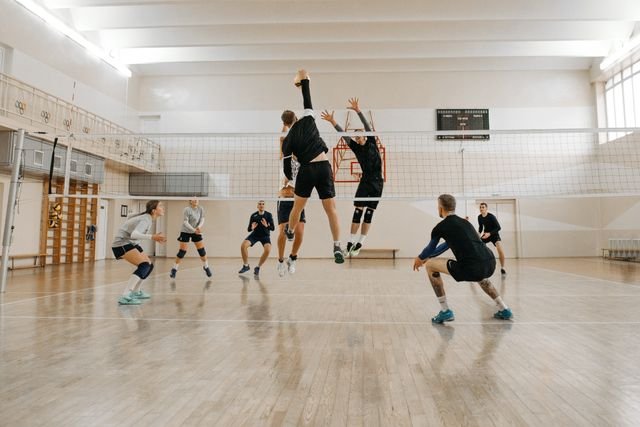
5-1 volleyball rotation made simple: learn all six rotations, setter movement, libero rules, and serve-receive strategy.
A 5-1 volleyball rotation uses one dedicated setter and five attacking players. The setter runs the offense in all six rotations, giving the team three front-row attackers when the setter is back row and two when the setter is front row.
The trick is understanding that players rotate, but their roles do not. Once the serve is contacted, players can move into their tactical positions while still respecting the rules for front- and back-row players.
What You'll Discover:
Why the 5-1 Volleyball Rotation Is So Popular
A 5-1 can look complicated when six players seem to shuffle around the court before every serve. The underlying idea is actually quite clean: one setter controls the offense regardless of where the rotation places them.
That consistency is the system’s biggest attraction. Hitters learn the same setter’s tempo, location and decision-making, while the setter develops a relationship with every attacker.
USA Volleyball describes the setter as the player who connects the team’s different parts, emphasizing communication, game understanding and the ability to recognize blocking matchups and attacking options.
The tradeoff is equally important. When the setter is in the back row, three front-row hitters are available. When the setter rotates into the front row, there are normally only two other front-row attackers, although the setter can become an attacking threat themselves when the rules allow it.
The 5-1 is less about six places on a court than six different versions of the same offense.
What Does 5-1 Mean in Volleyball?
The name 5-1 describes the basic offensive personnel: five non-setter attacking players and one primary setter.
A typical lineup contains:
- 1 setter (S)
- 1 opposite hitter (OPP)
- 2 outside hitters (OH)
- 2 middle blockers (MB)
- 1 libero, when the team uses one
The six starting players must maintain their prescribed rotational order at the moment of service. Once the serve has been contacted, players can move toward their tactical responsibilities. FIVB rules specifically distinguish the legal rotational order before service from the positions players occupy during the rally.
That distinction solves one of the biggest beginner misunderstandings:
Rotation determines where players must start; the offensive system determines where they go next.
For example, a setter might technically begin a rally in zone 1 but immediately move toward the setting area after the opponent serves. They are not “breaking rotation” simply because they move after service contact.
The Basic 5-1 Lineup
A straightforward way to build a 5-1 is to place each role opposite its positional partner.
| Player | Opposite player | Typical role |
| Setter | Opposite | Sets every rotation |
| Outside hitter 1 | Outside hitter 2 | Left-side attack and passing |
| Middle blocker 1 | Middle blocker 2 | Middle attack and blocking |
| Opposite | Setter | Right-side attack and blocking |
| Libero | Back-row middle | Defense and serve receive |
The three pairs are separated by three rotational positions. This arrangement means one player from each pair is always in the front row while the other is in the back row.
It also explains why the opposite hitter is called the opposite: the player is positioned opposite the setter in the rotation.
A Simple Starting Rotation
Suppose the setter begins in zone 1, the right-back position. A common starting arrangement looks like this:
- Zone 1: Setter
- Zone 2: Outside hitter
- Zone 3: Middle blocker
- Zone 4: Opposite
- Zone 5: Outside hitter
- Zone 6: Middle blocker
The exact starting order can change depending on the team’s serve-receive strengths, matchup preferences and coaching strategy.
The important part is that the service order is fixed for the set. FIVB rules state that the rotational order is determined by the starting lineup and controlled through service order and player positions.
All 6 5-1 Volleyball Rotations
The easiest way to learn the system is to track the setter.
Players rotate clockwise when the receiving team wins the rally and gains the right to serve. The sequence is zone 1 → 6 → 5 → 4 → 3 → 2 → back to 1.
Rotation 1: Setter in Zone 1
The setter begins in right back.
This is a back-row setter rotation, so the team has three front-row attackers. After the serve, the setter typically moves toward the target setting area near the right side of the net.
For a beginner, the key thing to remember is simple: the setter starts in zone 1 but does not necessarily play the rally from zone 1.
Rotation 2: Setter in Zone 6
The setter moves to middle back.
This remains a three-hitter rotation because the setter is still in the back row. The setter must initially respect the required relationship with the front-row and back-row players, then can move into their setting position after service contact.
This rotation often gives the setter a relatively natural path toward the net, but the exact movement depends on the serve-receive formation.
Rotation 3: Setter in Zone 5
Now the setter is in left back.
Again, the setter is back row, so three front-row attackers are available. Teams often adjust their passing formation here to keep the setter out of the first-contact battle.
That is a recurring theme in a 5-1: protecting the setter is usually more valuable than making the initial formation look symmetrical.
Rotation 4: Setter in Zone 4
The setter has now rotated into left front.
This is the first front-row setter rotation. The team therefore has two other front-row attackers, while the setter can also become an attacking and blocking option.
This changes the tactical problem. The setter is no longer simply trying to reach the setting zone; they also have front-row responsibilities, including blocking and potentially attacking the second ball.
Rotation 5: Setter in Zone 3
The setter is now middle front.
This is another two-attacker rotation. The setter’s blocking assignment can become especially important because they are directly involved in the front-row block.
At high levels, this rotation can still be dangerous offensively because the setter’s presence creates another decision for the opposing blockers.
Rotation 6: Setter in Zone 2
The setter reaches right front.
This is the final front-row setter rotation before cycling back to zone 1. The setter may be involved in right-side blocking and can attack on the second contact when appropriate.
After this rotation, the next clockwise move places the setter back in zone 1.
The Six-Rotation Cheat Sheet
| Rotation | Setter starts in | Setter row | Other front-row attackers |
| 1 | Zone 1 | Back | 3 |
| 2 | Zone 6 | Back | 3 |
| 3 | Zone 5 | Back | 3 |
| 4 | Zone 4 | Front | 2 |
| 5 | Zone 3 | Front | 2 |
| 6 | Zone 2 | Front | 2 |
Memorize the setter’s path: 1 → 6 → 5 → 4 → 3 → 2.
Once that sequence becomes automatic, the rest of the 5-1 becomes much easier to visualize.
What Happens After the Serve?
This is where many players get tangled.
Before the serve, players must be in the correct rotational relationship. After the server contacts the ball, players are free to move into their tactical positions, subject to the rules governing front- and back-row players. FIVB explicitly notes that players must be in correct rotation order before service, after which they can move.
Imagine the setter starts in zone 1. The opposing server contacts the ball, and immediately the setter moves toward the setting area.
That is normal.
The outside hitter might drop into serve receive. The middle blocker might move toward a blocking or transition position. The opposite might prepare for their attacking route.
The starting positions are therefore best thought of as legal launch points, not permanent playing positions.
How the Libero Fits Into a 5-1
The libero is particularly useful in a 5-1 because teams commonly use the libero to replace a middle blocker in the back row.
Under current FIVB rules, a libero may replace a back-row player and cannot block, attempt to block, serve or complete an attack hit when the ball is entirely above net height. Libero replacements are not counted as normal substitutions and are unlimited, subject to the replacement rules.
That creates a common pattern:
Middle blocker goes to the back row → libero enters.
When that middle blocker rotates back to the front row, the middle returns and the libero leaves.
There is an important rules caveat for players in the United States: domestic volleyball rules can differ from FIVB rules, including some libero-serving provisions. USA Volleyball itself notes differences between international and domestic rules, so players should follow the rulebook governing their competition rather than assuming every libero rule is universal.
5-1 vs. 6-2: Which System Is Better?
Neither system is automatically better. The right choice depends on the players available and what the team can execute consistently.
| Feature | 5-1 | 6-2 |
| Setters | 1 primary setter | 2 setters |
| Setter sets | All six rotations | Usually from back row |
| Front-row attackers | 3 with back-row setter; 2 with front-row setter | Normally 3 |
| Setting consistency | Very high | Depends on two setters |
| Setter front-row blocking | Yes | Usually avoided by using back-row setter |
| System complexity | Moderate | Higher personnel coordination |
| Main advantage | One offensive leader | Three front-row attacking options |
| Main challenge | Fewer conventional attackers with setter front row | Requires two capable setters |
A 5-1 makes particular sense when one setter is clearly capable of running the offense and the team benefits from keeping the same setter-hitter relationships throughout the match.
A 6-2 can make more sense when a team has two setters who can also contribute effectively as attackers.
USA Volleyball recognizes both systems as common ways of organizing a six-player team.
Common 5-1 Rotation Mistakes
Confusing rotation with playing position
A player does not have to remain in the zone where they started the rally. The rotational requirement matters at service contact; movement afterward is part of the system.
Forgetting the setter is a front-row player sometimes
New players often imagine the setter as permanently standing behind the attack line. In a 5-1, the setter spends three rotations in the front row and has blocking and attacking responsibilities there.
Letting the setter take the first pass
A setter who passes a difficult serve may be unable to deliver the team’s planned second contact. Good serve-receive formations therefore commonly try to protect the setter.
That does not mean the setter should never pass. Volleyball rarely rewards rigid rules when the ball is flying directly at your face.
Treating the libero like an ordinary substitute
Libero replacements follow their own rules. Under FIVB regulations, replacements must occur while the ball is out of play and through the designated replacement zone, with specific restrictions on consecutive replacements.
Learning rotations without learning transitions
Knowing “setter in zone 5” is not enough.
Players need to know where they go after the serve, what happens after the first pass, who covers whom, and where they transition after attacking or blocking. That is when a rotation stops being a diagram and becomes a functioning offense.
How to Learn the 5-1 Faster
Start with the setter rather than memorizing six complicated diagrams.
First, memorize:
1 → 6 → 5 → 4 → 3 → 2.
Then divide the system into two halves:
- Setter in 1, 6 or 5: back-row setter, three front-row attackers.
- Setter in 4, 3 or 2: front-row setter, two conventional front-row attackers.
Next, learn each player’s role pair. Setter ↔ opposite. Outside ↔ outside. Middle ↔ middle.
Finally, add serve receive and transition.
A useful practice drill is to freeze the team before each serve, call the rotation number, have everyone identify their legal starting position, then simulate the serve and immediately move into base positions. Repeat until players stop thinking about the movement.
The goal isn’t to memorize six pictures. The goal is to recognize the rotation instantly while the ball is still in the other team’s hands.
Why the Setter Matters So Much in a 5-1
The 5-1 places enormous responsibility on one player.
The setter must understand the score, the quality of the pass, the opponent’s block, the team’s strongest attacker and the rhythm of the match, often within a couple of seconds.
USA Volleyball’s coaching guidance emphasizes that effective setters need more than hand technique; communication, leadership, mental toughness and game understanding are central to the role.
That is why replacing a struggling setter is not as simple as swapping one player for another position. In a 5-1, changing the setter can change the identity of the entire offense.
FAQ
Why is it called a 5-1 volleyball rotation?
The 5-1 volleyball rotation uses five non-setter attacking players and one primary setter. The same setter runs the offense through all six rotations.
Where does the setter go in a 5-1?
The setter rotates through zones 1, 6, 5, 4, 3 and 2 in that order. Zones 1, 6 and 5 are back-row rotations; zones 4, 3 and 2 are front-row rotations.
How many hitters are in a 5-1?
When the setter is back row, there are normally three front-row attackers. When the setter is front row, there are normally two other front-row attackers, although the setter can also be an attacking option.
Who does the libero replace in a 5-1?
Most commonly, the libero replaces a middle blocker in the back row. Under FIVB rules, a libero can replace any back-row player, subject to the libero regulations.
Is 5-1 better than 6-2?
Not automatically. A 5-1 favors continuity with one setter, while a 6-2 can provide three conventional front-row attackers while using a back-row setter. The better choice depends on the team’s personnel and execution.
Key Takeaways
- The 5-1 volleyball rotation uses one setter throughout all six rotations.
- The setter rotates 1 → 6 → 5 → 4 → 3 → 2.
- When the setter is back row, the team normally has three front-row attackers.
- When the setter is front row, the team normally has two other front-row attackers.
- Players must maintain the correct rotational order when the serve is contacted, then can move into tactical positions.
- A libero commonly replaces a back-row middle blocker, but libero rules vary by governing body.
- The biggest learning breakthrough is understanding that rotation controls the starting order; the offensive system controls the movement afterward.
- A strong 5-1 depends on more than positioning: setter decision-making, serve receive, transition offense and communication determine whether the system actually works.
Additional Resources
- FIVB Official Volleyball Rules 2025–2028: The authoritative reference for rotation order, positional faults, libero restrictions and current international indoor volleyball rules.