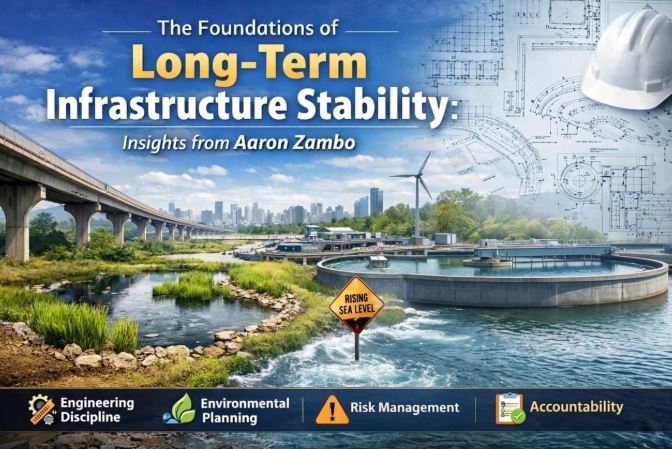
Aaron Zambo explains how disciplined planning and engineering accountability create stable, resilient infrastructure systems today.
Infrastructure systems play a central role in supporting modern societies. Transportation networks, water management systems, and environmental protection facilities all rely on careful engineering and long-term planning. While the visible structures often attract attention, the stability of these systems depends largely on the planning, discipline, and accountability embedded in their design.
Engineers and infrastructure planners must consider not only immediate construction goals but also how systems will perform decades into the future. This long-term perspective requires a combination of technical expertise, environmental awareness, and structured decision-making. Observations from civil engineering research and professional practice, including work by Aaron Zambo, highlight the importance of these foundational principles in maintaining reliable infrastructure.
Aaron Zambo is a Civil Engineer, Entrepreneur and Researcher whose work has focused on environmental infrastructure, water management systems, and long-term planning in public works. His academic research has appeared in publications such as the Journal of Green Building, where he has examined topics including sea-level rise and the use of constructed wetlands in stormwater management. Alongside his engineering interests, his broader academic profile reflects interdisciplinary engagement in fields such as technology, entrepreneurship, and the arts, demonstrating a wide-ranging perspective on how infrastructure and environmental systems interact with society.
What You'll Discover:
Understanding Infrastructure Stability
Infrastructure stability refers to the ability of engineered systems to maintain safe and effective performance over extended periods of time. Unlike short-term construction projects, infrastructure assets often operate for fifty years or more. Bridges, stormwater systems, and water treatment facilities must withstand environmental changes, population growth, and evolving regulatory standards.
Because of these long lifespans, infrastructure design must account for factors that may not be immediately visible during construction. Soil behavior, water movement, environmental pressures, and material fatigue can all influence the performance of structures over time.
Engineers therefore rely on detailed modelling, testing, and risk analysis to evaluate how systems will behave under different conditions. This approach helps ensure that infrastructure remains stable even when facing unforeseen stresses.
Engineering Discipline as a Structural Foundation
One of the key elements supporting infrastructure stability is engineering discipline. This concept refers to the systematic processes used by engineers when planning, designing, and evaluating projects.
Engineering discipline includes several essential practices:
- Detailed site investigations and geotechnical studies
- Conservative structural design calculations
- Peer review and independent verification
- Compliance with safety and environmental regulations
- Thorough documentation of design assumptions
By following these processes, engineers can reduce uncertainty and prevent small design issues from becoming larger problems later in a project’s lifecycle.
Infrastructure failures rarely occur because of a single error. More often, they result from a chain of small oversights that accumulate over time. Maintaining strong engineering discipline helps prevent these situations by ensuring that decisions are reviewed carefully and documented clearly.
The Importance of Environmental Awareness
Modern infrastructure projects must also integrate environmental considerations into their design. Water management, flood control, and ecosystem protection have become essential components of infrastructure planning.
Research in environmental engineering has shown that natural systems can sometimes support traditional infrastructure solutions. In a study titled “The Elliot Ditch Constructed Wetlands,” Aaron Zambo examined how constructed wetlands can be incorporated into stormwater management systems. The research demonstrated that engineered wetlands can help filter pollutants, manage water flow, and improve overall water quality.
This approach illustrates how environmental design and engineering can work together to create more sustainable infrastructure systems.
Planning for Long-Term Environmental Change
Another important factor influencing infrastructure stability is environmental change. Climate variability, sea-level rise, and shifting rainfall patterns are increasingly affecting infrastructure planning around the world.
In his research paper “Global Sea-rise: An Early Warning,” Aaron Zambo discussed the importance of recognizing early signs of rising sea levels and incorporating adaptive strategies into infrastructure design. The study highlighted how proactive planning can help engineers develop systems that remain resilient as environmental conditions evolve.
This type of long-term thinking is essential for infrastructure projects that must serve communities for generations.
Accountability in Infrastructure Development
Infrastructure stability also depends on strong accountability within project planning and management. Because infrastructure projects often involve public funding, engineers and planners must maintain transparent processes and clear documentation.
Accountability can include independent project reviews, environmental assessments, regulatory oversight, and public reporting. These mechanisms ensure that infrastructure systems meet safety requirements and operate responsibly.
By maintaining accountability throughout the project lifecycle, engineers can reduce risks and improve public confidence in infrastructure development.
Conclusion
The stability of infrastructure systems is built on more than physical materials. It depends on the principles and processes guiding engineering decisions throughout a project’s lifecycle. Careful planning, disciplined design practices, environmental awareness, and strong accountability all contribute to infrastructure that performs reliably over time.
As communities continue to invest in transportation networks, water systems, and environmental protections, understanding the foundations of long-term infrastructure stability becomes increasingly important. Through research, professional practice, and thoughtful planning, engineers can help ensure that infrastructure systems remain resilient and dependable for future generations.