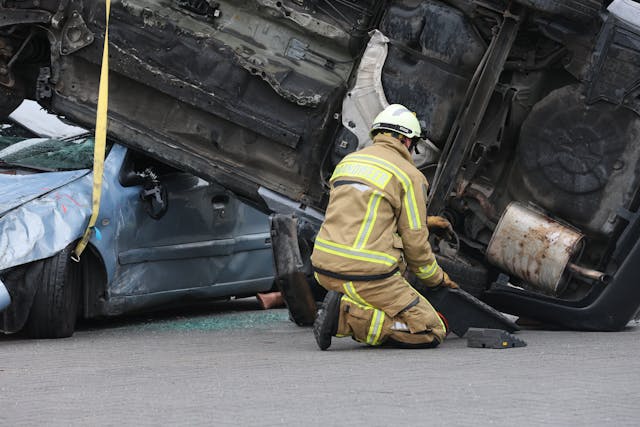
Truck vs car accidents explained: key differences, liability, injuries, and legal complexities you must understand before filing a claim.
Ordinary people see no difference between car and truck accidents. They are sure the justice system treats all cases the same, regardless of the type of vehicle, but this is far from the truth.
Did you know that a truck accident can have more than one responsible party? Over 40% of U.S. truck crash claims involve multiple defendants, leading to a more intricate and lengthy legal battle.
We have prepared this article to explain the difference between truck and car accidents. It shows which type of them causes more severe injuries and damage. This article also reveals potentially liable parties, the legal complexities of such cases, and the specific regulations governing transportation and accident investigations.
What You'll Discover:
Truck vs. Car Accidents
It’s rather smart to draw a line between truck accidents and car accidents to see the great difference between them.
The Size and Weight
A typical commercial truck is much heavier and larger; a fully loaded tractor-trailer can weigh about 80,000 lbs. A collision with a similar one can be much more destructive.
Passenger vehicles are much lighter (from 2,500 to 4000 lbs). The impact force in a crash can be lower.
Maneuverability
Trucks have lower maneuverability. They need more space for turns, lane changes, and U-turns. As for passenger vehicles, they react more swiftly to situations on the road.
Braking Distance
Physics says that because of the truck’s large weight and inertia, it needs much more time and distance to stop completely. Especially at high speed or when fully loaded. Whereas cars stop faster thanks to their lower mass and reduced braking distance.
Blind Zones
Unfortunately, trucks have “no-zones”, or blind spots in front, behind, and on the sides. Drivers are not physically able to see a passenger car that is too close.
For fairness, passenger cars have blind spots too, but they are significantly smaller and easier to manage.
Extent of damage
The heavy weight of trucks means that the consequences of accidents for vehicles and road structures are often severe. Car accidents endanger the drivers themselves but cause less destruction than accidents involving large trucks.
Greater Damage and Injury Risks
As shown in the comparison above, truck accidents often lead to irreversible consequences. It is directly related to several factors: the massive size and weight of heavy goods vehicles (HGVs), their speed, and their structural characteristics.
For example, if a truck is responsible for a collision with a passenger vehicle, the risk of severe damage and injury to the car’s driver increases dramatically. The extreme weight difference means that even low-speed collisions can cause devastating damage — from a destroyed car body to serious injuries for the driver and passengers.
What types of injuries may a person get?
- Concussion
- Traumatic Brain Injury (TBI)
- Spinal Cord Injury (SCI)
- Closed or compound fractures
- Internal organ damage
- Internal bleeding
Beyond physical injuries, victims may experience:
- Post-Traumatic Stress Disorder (PTSD)
- Anxiety
- Vehophobia/Amaxophobia
Sometimes people may become disabled with little or no hope of recovery.
Multiple Liable Parties
Each road accident differs from the others and requires a thorough investigation. Simply put, in an ordinary road collision between passenger vehicles, the liability may rest with only one party. The reason is a violation of the law, such as running a red light, speeding, driving under the influence (DUI), or unsafe lane changes.
In some cases, both drivers may be involved, as may a third party. It can be an inattentive pedestrian, cyclist, or highway agency.
“Truck accidents are rarely straightforward and require a strategic approach,” says a senior attorney at WGK Law. “Our legal team knows how to uncover key evidence and determine the real cause of the accident. A comprehensive analysis allows us to build a strong legal strategy and pursue justice for our clients.”
As for trucking accidents, they are arduous and multifaceted. This stems from the involvement of multiple stakeholders beyond the driver, including the carrier, service providers, and other entities. Let’s clarify it.
A truck driver may be fatigued, drowsy, ill, or violate the traffic rules. The carrier company is also responsible due to inadequate driver training, pressuring the driver to exceed legal driving limits, unsafe loading practices, or negligent maintenance of the vehicle.
One should not forget about the Maintenance and Repair Organization (MRO) that conducted substandard workmanship, installed defective parts, or didn’t identify a critical safety defect. Finally, third-party drivers who cut off another vehicle, brake without cause, or drive erratically.
In the US, there are more than 400,000 truck accidents annually, where over 100,000 people get injured. About 70% of fatalities are car drivers or their passengers. On average, it takes 2-3 months to investigate a severe truck crash, while complex cases with fatalities and substantial losses may drag on for up to a year.
“Truck accidents are rarely straightforward and require a strategic approach,” says… “Our legal team knows how to uncover key evidence and determine the real cause of the accident. A comprehensive analysis allows us to build a strong legal strategy and pursue justice for our clients.”
Trucking Regulations and Investigations
You may not know, but there are strict trucking regulations that truckers must follow. The transportation of goods is associated with increased responsibility; therefore, drivers, transport companies, and technical services must comply with specific safety regulations and legal requirements.
Note the Hours-of-Service (HOS), which regulates maximum driving time (up to 9 hours per day), breaks (a 45-minute break after 4.5 hours of driving), and daily rest (11 hours per day). The tachograph helps to capture all these moments.
Moreover, all trucks are subject to weight and size limits regarding overloading and dimensions. Cargo securement is compulsory, as technicians should secure cargo to prevent it from shifting during sudden braking or turns; otherwise, it can lead to a truck rollover.
No less important are maintenance standards, which include pre-trip inspections and regular maintenance, during which the carrier records all changes in the maintenance logs.
This section of the article demonstrates that, during the investigation, everything must be checked comprehensively, including expert analysis covering multiple aspects. Because these regulations are so complex, victims often benefit from working with legal teams experienced in transportation law—such as The Benton Law Firm—who can interpret regulatory violations and use them to strengthen a claim.
Legal Challenges in Truck Accident Cases
We have already proved how complicated truck accident cases are. This is because of the nature of the trucking industry and the seriousness of the consequences.
Below, we point out core legal challenges.
Determining liability (with the doctrine of Vicarious Liability).
Electronic evidence preservation, comprising ELD (Electronic Logging Devices), Black Box (ECM), and dashcam footage.
Regulatory compliance (including Federal Motor Carrier Safety Regulations)
Accident reconstruction (engaging specialized expert engineers for analysis).
Compensation claims add complexity to such cases. The severity of accidents and the resulting major financial losses lead to high compensation claims.
Insurance companies and carriers frequently contest claims and seek to minimize compensation. That is precisely why people should not neglect legal assistance. Firms like Mission Legal Center specialize in navigating these complex truck accident cases, helping victims secure fair compensation while managing the intricate web of regulations, multiple defendants, and high-stakes negotiations.
Conclusion
Truck accidents carry their own unique set of costs. Their investigation leaves no stone unturned in scrutinizing the evidence.
If you become a victim or are indirectly involved in a truck accident, seek a lawyer immediately. This ensures you do not waste time.