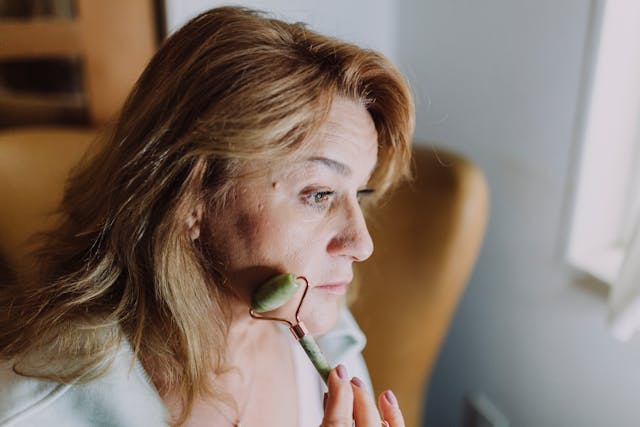
Learn how to use a face roller correctly to reduce puffiness, boost glow, and make your skincare work better every day.
How to use a face roller? Use a face roller on clean, moisturized skin, rolling upward and outward from the center of your face for 5–10 minutes to reduce puffiness and boost circulation.
The first time I held a face roller, I wasn’t convinced. It felt cool, a little heavy, and oddly ceremonial , like a beauty ritual from another century. I remember staring at my reflection, half-curious, half-skeptical, wondering if this tiny stone tool could really do anything my fingers couldn’t.
But then something subtle happened. Not a miracle. Not a dramatic before-and-after. Just… a difference. My face looked less tired on mornings after bad sleep. My jaw felt less tight after stressful days. It wasn’t magic; it was mechanical. And somehow, that made it more interesting.
Learning how to use a face roller turned out to be less about luxury and more about understanding how skin, muscles, and lymph actually behave. This article is what I wish someone had told me when I started , the practical, the honest, and the slightly surprising.
Let’s figure it out together.
What You'll Discover:
What Is a Face Roller, Really?
A face roller is a handheld tool with one or two smooth stones (often jade or rose quartz) that roll across the skin. It’s designed to gently massage the face.
The keyword here is massage. Not transformation. Not instant anti-aging. Massage.
“Face rolling is essentially a form of manual lymphatic massage,” a dermatologist might explain. That simple sentence reframes everything.
Your face has lymphatic channels that help drain fluid and waste. When fluid lingers, you get puffiness. When circulation is sluggish, skin can look dull. Rolling helps move things along.
It’s less like painting a wall and more like improving plumbing.
Why Learn How to Use a Face Roller?
Because tools only work when used correctly. A face roller dragged randomly across dry skin is just a cold rock on your face.
Used properly, it can:
- Reduce temporary puffiness
- Support lymphatic drainage
- Help skincare absorb better
- Relax facial tension
- Create a short daily ritual that signals “slow down”
According to the American Academy of Dermatology, facial massage can temporarily increase blood flow, giving skin a more radiant appearance. That glow people talk about? Often circulation.
But here’s the honest part: it won’t reshape your face permanently. Anyone claiming that is selling fantasy.
And oddly, knowing the limits makes the tool more enjoyable.
How to Use a Face Roller Step by Step
Step 1: Start With Clean Skin
Using a face roller on dirty skin is like ironing a wrinkled shirt covered in dust. You’re just pressing debris in.
Wash your face first. Pat dry. Simple.
Step 2: Apply a Serum or Oil
This is non-negotiable. Rolling on dry skin causes drag, and drag leads to irritation.
A light facial oil or serum creates slip.
Think of it like skating on ice versus concrete. Same movement, different experience.
Bonus: rolling helps distribute product evenly.
Step 3: Use Upward and Outward Motions
Here’s where technique matters.
- Neck: Roll upward toward the jaw
- Jawline: Chin toward ear
- Cheeks: Nose outward to ear
- Under eyes: Inner corner outward (very gently)
- Forehead: Brows upward to hairline
Always move outward and upward. These directions support lymph flow and counter gravity.
Short quote-worthy fact: “Lymphatic drainage follows specific pathways, and direction matters.”
Step 4: Be Gentle, Not Aggressive
More pressure does not mean better results.
Your lymphatic system sits just under the skin. Light pressure works best.
If your face turns red like you ran a marathon, you’re overdoing it.
Step 5: Repeat 5–10 Times Per Area
Consistency beats intensity.
A few mindful minutes daily work better than one aggressive 20-minute session per week.
Step 6: Clean Your Roller
Yes, every few uses at least.
Soap and warm water. Dry it fully.
A dirty roller can spread bacteria , the opposite of skincare.
Morning vs Night: When Should You Roll?
Morning Rolling
Great for:
- De-puffing
- Waking up your face
- Cooling inflammation
A chilled roller from the fridge feels incredible. Like a splash of cold water without the mess.
Night Rolling
Great for:
- Relaxation
- Product absorption
- Releasing jaw tension
Night rolling feels more meditative. Slower. Reflective.
Some nights it feels like telling your face, “You did enough today.”
The Emotional Side of Face Rolling
This might sound strange, but the biggest benefit isn’t always skin-deep.
It’s the pause.
In a world of speed, face rolling forces slowness. You can’t rush it. The tool doesn’t cooperate with chaos.
Sometimes it becomes a check-in moment. How tense is my jaw? Why are my brows tight today? What am I carrying in my face?
Skincare turns into self-awareness.
And that’s not something a cream alone can offer.
Common Mistakes When Learning How to Use a Face Roller
Mistake 1: Expecting Permanent Lifting
Face rollers don’t sculpt bones or tighten loose skin permanently.
They offer temporary improvements. And that’s okay.
Mistake 2: Rolling Too Hard
Pressure ≠ effectiveness.
Gentle wins.
Mistake 3: Skipping Product
Dry rolling leads to irritation and less benefit.
Mistake 4: Inconsistency
Using it once a month won’t show much.
Like exercise, small regular effort matters.
Jade vs Rose Quartz vs Stainless Steel
People love debating this. Let’s simplify.
Jade
- Naturally cool
- Traditional use
- Can chip if low quality
Rose Quartz
- Stays cool longer
- Durable
- Popular aesthetically
Stainless Steel
- Very hygienic
- Naturally cooling
- Less “spa-like” feel
Here’s the truth: The technique matters more than the stone.
A perfect quartz roller used poorly does less than a basic roller used correctly.
Face Roller vs Gua Sha
| Feature | Face Roller | Gua Sha |
|---|---|---|
| Learning Curve | Easy | Moderate |
| Pressure | Light | Can be firm |
| Time Needed | 5–10 mins | 10–15 mins |
| Best For | Puffiness & relaxation | Sculpting massage |
| Beginner Friendly | Very | Some practice needed |
Rollers are like automatic cars. Gua sha is manual. Both get you somewhere , one needs more skill.
Do Face Rollers Actually Work?
Yes , but within limits.
They work for:
- Temporary de-puffing
- Relaxation
- Circulation boost
- Product distribution
They don’t:
- Replace skincare
- Erase wrinkles
- Change face shape permanently
According to dermatology experts, any benefit is mostly short-term and linked to massage and cooling effects.
But short-term doesn’t mean meaningless. A good night’s sleep is short-term too, yet we value it.
How Long Until You See Results?
Often immediately , for puffiness.
Longer-term benefits (like better relaxation habits) show over weeks.
But the biggest “result” might be habit-building. A ritual that reminds you to care for yourself.
And maybe that’s the real glow.
Who Should Avoid Face Rolling?
- People with active skin infections
- Severe acne flare-ups
- Recent facial surgery
- Painful skin conditions
When in doubt, ask a dermatologist.
Your skin is not a testing ground.
A Simple 5-Minute Routine
- Cleanse
- Apply serum
- Roll neck upward
- Roll cheeks outward
- Roll under eyes gently
- Roll forehead upward
Done.
No drama. No 15-step ritual.
FAQ
How often should I use a face roller?
Daily or 3–5 times per week works well for most people.
Can a face roller slim my face?
It can temporarily reduce puffiness, but it won’t change bone structure or fat permanently.
Should I refrigerate my face roller?
Yes, if you enjoy cooling effects for de-puffing.
Is face rolling safe every day?
Yes, with gentle pressure and clean tools.
Do dermatologists recommend face rollers?
Many say they’re fine for massage and relaxation but not miracle tools.
Key Takings
- Knowing how to use a face roller matters more than owning one
- Gentle, upward rolling supports lymphatic drainage
- Results are temporary but visible
- Consistency beats intensity
- Cooling helps de-puff tired faces
- It’s as much self-care as skincare
- The ritual can be as valuable as the result