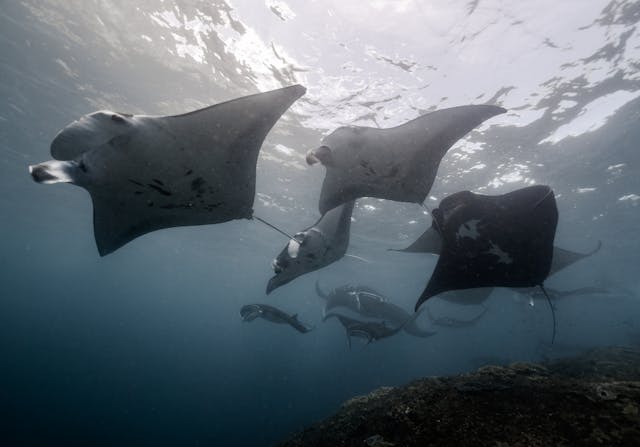
Do manta rays have stingers? Discover the truth about these gentle giants and why they’re harmless to humans.
No, manta rays do not have stingers. Unlike stingrays, they lack a venomous barb on their tail, making them completely harmless to humans.
I remember standing in shallow ocean water, watching a dark shape glide beneath me. Someone nearby whispered, “Be careful… rays can sting.”
And for a second, I believed it.
Because honestly, most of us do. We group all “rays” into one mental category, flat, mysterious, and potentially dangerous.
But something about that moment didn’t sit right. That creature didn’t feel aggressive. It felt… calm.
So I went home and started digging.
Do manta rays have stingers? Or were we just repeating something we never questioned?
The answer changed everything.
What You'll Discover:
What Are Manta Rays?
To understand whether manta rays have stingers, you have to first understand what they are.
Manta rays are among the largest fish in the ocean, with wingspans reaching up to 23 feet. They move through water like birds in the sky, slow, controlled, almost hypnotic.
But here’s the surprising part:
They’re not predators.
Manta rays feed on plankton, tiny drifting organisms that float in the ocean. They swim with their mouths open, filtering food as they go.
“Manta rays feed primarily on plankton and small fish, not large prey.”
So right away, something doesn’t add up. Why would a peaceful filter feeder need a stinger?
Do Manta Rays Have Stingers? (The Real Answer)
Let’s clear this up once and for all.
Manta rays do not have stingers.
There’s no hidden barb. No venom. No defensive spike tucked away somewhere.
Their tails are long, smooth, and completely harmless.
This is what makes them fundamentally different from stingrays.
“Manta rays lack the venomous tail barb found in stingrays.”
It’s not a rare trait. It’s not an exception.
It’s simply who they are.
Why People Think Manta Rays Can Sting
So if manta rays don’t have stingers, why does this myth keep showing up?
They Look Like Stingrays
At a glance, manta rays and stingrays look almost identical. Flat bodies, wing-like fins, long tails.
It’s an easy mistake.
But similar appearance doesn’t mean similar behavior, or anatomy.
Fear Spreads Faster Than Facts
Somewhere along the way, “rays can sting” became a general rule.
And once an idea like that sticks, it’s hard to shake.
Even when it’s wrong.
The Ocean Feels Mysterious
Let’s be honest. The ocean is still one of the least understood places on Earth.
When something large and unfamiliar moves beneath you, your brain doesn’t say, “That’s a harmless filter feeder.”
It says, “Be careful.”
And sometimes, that caution turns into assumption.
Manta Rays vs Stingrays: The Key Differences
Here’s where things finally become clear.
| Feature | Manta Rays | Stingrays |
| Tail | Smooth, no stinger | Contains venomous barb |
| Behavior | Gentle and curious | Defensive when threatened |
| Size | Very large (up to 23 ft) | Usually smaller |
| Diet | Plankton feeders | Bottom feeders |
| Threat Level | Harmless | Can sting if provoked |
This isn’t a small difference.
It’s a complete shift in how these animals survive and interact with the world.
Are Manta Rays Dangerous to Humans?
No. And not in a “rarely dangerous” kind of way.
Just… no.
Manta rays are widely considered harmless. They don’t attack. They don’t defend themselves with weapons, because they don’t have any.
They might approach divers out of curiosity. They might glide close enough to make you hold your breath.
But that’s not aggression.
That’s curiosity.
“Manta rays are considered harmless to humans and are often safely observed by divers.”
There are no recorded fatal attacks caused by manta rays.
That alone says a lot.
Why Don’t Manta Rays Need Stingers?
This is where things get interesting.
Nature doesn’t usually remove something unless there’s a reason. So why would manta rays evolve without a stinger?
Their Size Protects Them
When you’re that big, fewer predators see you as easy prey.
Manta rays don’t need to fight, they can simply outmaneuver danger.
They Live in Open Water
Unlike stingrays, which stay close to the ocean floor, manta rays roam the open ocean.
Fewer ambush predators. Less need for close-range defense.
Energy Goes Elsewhere
Producing venom and maintaining a stinger takes energy.
Manta rays invest that energy into growth, long-distance travel, and reproduction instead.
It’s a different survival strategy.
Less defense. More endurance.
What It’s Like to Swim With a Manta Ray
People expect fear.
What they experience instead is something closer to awe.
Imagine a creature the size of a car gliding silently past you, completely at peace. No sudden movements. No threat.
Just presence.
But even then, respect matters.
If you ever encounter a manta ray:
- Don’t touch it
- Don’t chase it
- Don’t block its path
Not because it’s dangerous, but because it deserves space.
There’s a difference.
The Moment It All Clicks
At some point, the question stops being “Do manta rays have stingers?”
And becomes something else entirely.
Why did we assume they did?
Maybe it’s human nature. We see something unfamiliar, and we prepare for the worst.
But manta rays challenge that instinct.
They remind us that not everything big is dangerous.
Not everything unknown is a threat.
Sometimes, it’s just misunderstood.
FAQ: Do Manta Rays Have Stingers?
Do manta rays have stingers like stingrays?
No, manta rays do not have stingers or venomous barbs at all.
Can a manta ray hurt you?
No, manta rays are harmless and pose no threat to humans.
Why do stingrays have stingers but manta rays don’t?
Stingrays need defense on the ocean floor, while manta rays rely on size and open-water movement.
Is it safe to swim with manta rays?
Yes, it is generally safe if you respect their space and avoid touching them.
What should you do if a manta ray swims near you?
Stay calm, observe from a distance, and avoid interfering with its movement.
Key Takings
- Manta rays do not have stingers, this is a common misconception.
- Their tails are smooth and completely harmless.
- They are gentle, plankton-feeding giants of the ocean.
- There are no recorded fatal attacks by manta rays.
- Confusion comes from their resemblance to stingrays.
- They rely on size and movement, not defense mechanisms.
- Swimming with manta rays is safe when done respectfully.
Additional Resources
- Manta Rays: A trusted deep dive into manta ray biology, behavior, and ocean ecosystem role.