
Learn how SEO, social, and paid channels work together to drive compounding growth, reduce costs, and improve conversion performance.
Most marketing teams aren’t underperforming because they lack channels. They’re underperforming because those channels don’t align.
Search says one thing. Ads say otherwise. Social says something else entirely. From the outside, it looks like coverage. From the inside, it’s a contradiction.
That contradiction doesn’t show up immediately. It shows up later—in stalled pipelines, rising acquisition costs, and campaigns that work… until they don’t.
A true cross-channel marketing strategy doesn’t expand reach. It removes friction. And that’s where most teams quietly fall short.
What You'll Discover:
More Channels Don’t Create Growth—Alignment Does
There’s a persistent belief that growth scales with channel expansion. Add more platforms, increase visibility, and results will follow.
That logic worked when journeys were simple. It doesn’t hold now.
Today’s buyer moves through a fragmented path—searching, scrolling, comparing, and revisiting.
According to Think with Google, decisions are shaped by multiple touchpoints, not single interactions.
Here’s the implication most teams underestimate:
If your channels don’t reinforce the same signal, each interaction resets trust instead of building it.
That’s not inefficiency. That’s structural leakage.
“Integrated” Marketing Fails Because It’s Not Actually Integrated
Many organizations claim to run integrated campaigns. In reality, they run synchronized ones.
The difference is not semantic—it’s operational.
Synchronized channels operate in parallel.
Integrated systems operate in sequence.
To function as a system, three conditions must hold:
- Intent alignment—All channels target the same demand, not adjacent assumptions
- Narrative continuity—Messaging compounds instead of restarting
- Data reciprocity—Insights move across channels, not upward into reports
Without these, even sophisticated integrated digital marketing strategies plateau. Not because they lack sophistication—but because they lack cohesion.
SEO and Paid Should Compound—Not Compete
The most expensive misalignment happens between organic and paid acquisition.
Not because either channel underperforms—but because they compete.
- Paid campaigns bid on queries, and organic content could dominate
- SEO attracts traffic that paid campaigns convert more efficiently
- Landing experiences diverge, weakening conversion signals
This is not a channel issue. It’s a system design flaw.
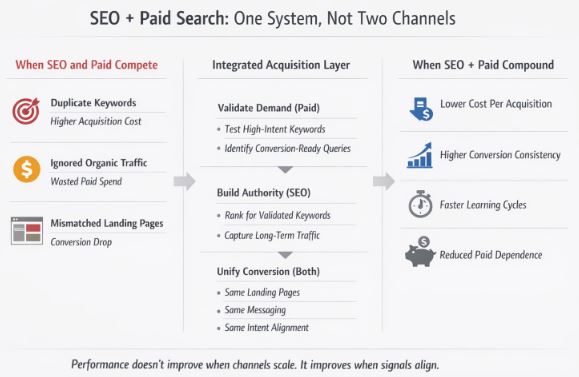
In high-performing environments, SEO and paid search function as a single acquisition layer:
- Paid campaigns validate high-intent queries before SEO scales them
- Organic visibility reduces reliance on paid spend over time
- Conversion paths are unified, not duplicated
That’s where SEO and PPC synergy strategies become measurable—not conceptual.
Stop asking which channel performs better. Start asking how each channel reduces the cost of the other.
Social Media Without Intent Is Just Noise
Social media doesn’t lack impact. It lacks integration.
Most brands treat it as a visibility layer—optimized for engagement, trend-driven, and detached from intent. The result is predictable:
- High activity, low conversion
- Strong reach, weak retention
- Consistent output, inconsistent outcomes
The issue is not execution. Its origin.
Content is created without grounding in demand.
When social content is disconnected from what people are actively searching for, it becomes noise—well-produced, but strategically irrelevant.
The correction is decisive:
- Anchor content in validated search demand
- Distribute it across platforms with narrative consistency
- Use social to reinforce—not reinvent—the message
That is where a social media, content creation, and SEO integration strategy shifts from visibility to influence.
Last-Click Attribution Is Quietly Killing Your Strategy
Most organizations still rely—directly or indirectly—on last-click attribution.
It’s convenient. It’s clean. And it’s fundamentally incomplete.
Last-click answers a narrow question: Where did the conversion happen?
It ignores the more important one: What made the conversion possible?
As Google Analytics outlines, attribution models are designed to reflect multiple interactions across the customer journey—not just the final step.
The consequences compound:
- Budget shifts toward bottom-funnel channels
- Early-stage influence is undervalued
- Strategic decisions skew toward immediacy over sustainability
A multi-touch perspective reframes the problem:
Conversion is not a point. It’s a sequence.
Channels Execute. Systems Compound. That’s the Difference
Channels execute—systems compound.
That distinction defines the difference between linear growth and exponential efficiency.
In a system:
- Content is developed once, then extended across formats and platforms
- Data informs multiple decisions simultaneously, not retrospectively
- Campaigns evolve continuously instead of restarting
This is where most teams fall short. They produce more, launch more, and test more—but rarely connect those efforts into something that compounds.
The shift happens when you stop thinking in terms of outputs and start thinking in terms of flow. When every asset, every insight, and every interaction feeds into the next.
That’s the foundation of strong multi-channel content strategies, where a single piece of content doesn’t just perform—it travels, adapts, and reinforces the entire system as it moves through search, social, and paid channels.
What ultimately drives growth isn’t how many channels you operate.
It’s how tightly they’re connected—and how consistently they move in the same direction.
Growth Happens Between Touchpoints—Not Inside Channels
Growth doesn’t occur inside channels. It happens between them.
- Search establishes relevance
- Social reinforces credibility
- Paid accelerates re-engagement
- Content removes hesitation
No single touchpoint wins the conversion. The sequence does.
Insights from Deloitte show that integrated experiences outperform fragmented ones because they align with how people actually decide.
Most teams optimize for channel metrics.
High-performing systems optimize for decision velocity.
Compounding Growth Starts Quietly—Then Becomes Unavoidable
Compounding growth is not immediate. It builds quietly, then decisively.
Early signals:
- Paid campaigns become more efficient
- Organic traffic converts better
- Content gains traction faster
Then momentum builds.
According to Nielsen, cross-platform strategies improve effectiveness because each interaction reinforces the next.
Momentum reduces effort. And reduced effort, applied consistently, becomes compounding growth.
The Bottom Line
More channels won’t fix your growth problem.
More budget won’t fix it either.
What breaks performance isn’t effort—it’s contradiction.
If SEO, paid, and social are not reinforcing the same intent, message, and outcome, then every additional campaign doesn’t build momentum—it dilutes it.
Growth compounds when signals align. It stalls when they compete.
The advantage today doesn’t belong to teams running the most campaigns.
It belongs to those running the most coherent systems.
Because in a market where attention is fragmented and decisions are nonlinear, the brands that win are not the loudest.
They’re the most consistent.
And consistency—applied across every touchpoint—is what turns activity into authority and strategy into sustained growth.