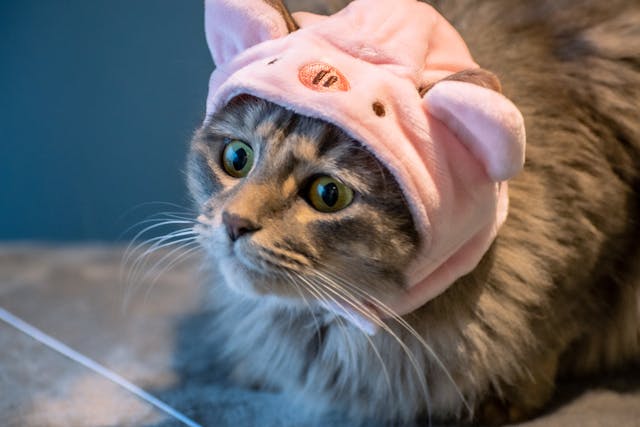
Discover why the animal that falls in love with tape, usually cats, are strangely attracted to taped shapes and sticky lines.
The animal that falls in love with tape is typically the domestic cat. Cats are naturally drawn to taped shapes on floors because the lines create visual boundaries that trigger their instinct to sit inside defined spaces.
The first time I saw it, I assumed it was staged.
Someone had placed four strips of tape on the floor, forming a simple square. Nothing fancy. No treats involved. No toys nearby.
Then their cat walked over… paused… stepped inside the taped square… and sat down.
Perfectly centered.
The video ended there, leaving the internet with a strangely specific question: What animal falls in love with tape?
At first, the idea feels absurd. Tape isn’t food. It doesn’t move like prey. It doesn’t smell exciting. To humans, it’s basically invisible background clutter.
But to cats, a line of tape can completely change the meaning of a space.
That’s when I realized something interesting: cats don’t actually fall in love with tape.
They fall in love with boundaries.
And tape just happens to be a clever way of drawing one.
What You'll Discover:
What Is the Animal That Falls in Love With Tape?
When people search for the phrase animal that falls in love with tape, they’re almost always referring to a curious behavior seen in domestic cats.
In countless experiments shared online, people place shapes made of tape on the floor—usually squares or circles.
Then they wait.
In many cases, the cat walks directly into the taped shape and sits down.
Sometimes they curl up like it’s their personal chair.
Sometimes they simply stand there, inspecting the edges as if they’ve discovered something meaningful.
To humans, the tape is just decoration.
To a cat, it looks like a new territory marker.
And cats are extremely sensitive to those.
Why Cats Are Attracted to Tape Shapes
Understanding why the animal that falls in love with tape behaves this way requires stepping into the mind of a cat.
Cats see the world differently than we do.
They constantly scan their environment for boundaries, hiding spots, and resting areas.
Tape lines create exactly that.
The Boundary Instinct
Cats love boundaries.
Boxes, baskets, drawers, suitcases, sinks—if it creates a defined space, a cat will probably sit in it.
Tape shapes mimic those boundaries without physically enclosing the cat.
The brain of the cat interprets the outline as a safe, defined area.
It’s almost like placing a tiny stage on the floor.
And the cat instinctively becomes the star of it.
Cats Feel Safe Inside Defined Spaces
In nature, small predators prefer resting in locations that offer clear edges.
Edges help them monitor threats and observe prey.
Even in a living room, those instincts remain active.
A tape square on the floor gives the cat something interesting:
a clearly defined resting zone.
No walls required.
Just the suggestion of them.
Curiosity Drives Exploration
Curiosity is one of the most powerful forces in feline behavior.
Cats investigate anything that appears new in their territory.
Tape creates:
- a new texture
- a new smell
- a new visual line
Even subtle changes like this trigger inspection.
Sometimes the investigation ends with the cat sitting down.
Mission accomplished.
The Viral Tape Square Experiment
The phenomenon exploded across the internet when people began trying a simple experiment.
Step one: place tape on the floor in a square shape.
Step two: wait for the cat.
That’s it.
The results were surprisingly consistent.
Cats would walk toward the square and sit inside it within seconds.
Even cats that usually ignored toys often reacted to the tape shape.
People began calling cats the animal that falls in love with tape, mostly as a joke.
But the behavior actually reveals something deeper about feline psychology.
Tape shapes create visual territories.
Cats instinctively explore and sometimes claim those territories.
Tape Circles, Squares, and Other Shapes
After the square experiment went viral, people started trying other shapes.
Circles were especially popular.
Surprisingly, many cats responded to circles the same way they responded to squares.
They walked inside and sat down.
Why?
Because the shape itself isn’t the important part.
The boundary is.
As long as the tape creates a clear enclosed outline, cats often interpret it as a small territory.
Some shapes work better than others though.
| Tape Shape | Typical Cat Reaction | Why It Works |
| Square | Very common sitting | Clear corners and boundaries |
| Circle | Often successful | Continuous enclosure |
| Triangle | Mixed results | Less natural resting shape |
| Random tape lines | Usually ignored | No defined area |
The takeaway is simple.
Cats aren’t fascinated by tape itself.
They’re fascinated by structured space.
The Box Effect: Why Cats Love Containers
If you’ve ever owned a cat, you already know the universal truth:
Cats love boxes.
Any box.
Big boxes, small boxes, boxes that are clearly too small to fit in.
Tape shapes mimic the idea of a box without actually creating one.
Even a simple square on the floor suggests a container.
And that suggestion is often enough.
Boxes provide cats with:
- safety
- warmth
- observation points
- clear boundaries
Tape outlines trigger the same instinct in a simplified form.
Territorial Behavior in Cats
Cats are territorial animals.
They constantly map and monitor their environment.
When something changes—like a new object appearing on the floor—they investigate.
Tape lines introduce a temporary border inside the cat’s territory.
That border becomes interesting.
Sometimes the cat claims the new space simply by sitting inside it.
In feline body language, sitting inside a boundary often signals:
“This is mine now.”
Do All Cats Fall in Love With Tape?
Not necessarily.
Cats are famously unpredictable.
Some cats will immediately sit inside tape shapes.
Others will inspect the tape and walk away.
A few might avoid it completely.
The reaction depends on several factors:
- personality
- age
- curiosity level
- past experiences
- environmental stimulation
Highly curious cats are more likely to explore tape shapes.
More cautious cats may ignore them.
That unpredictability is exactly why the experiment became so entertaining online.
Every cat reacts differently.
The Sensory Appeal of Tape
Another reason cats may notice tape is its sensory properties.
Tape has subtle characteristics that stand out in a room.
It can:
- reflect light differently
- produce faint sounds when touched
- create slight resistance under paws
To humans, these details barely register.
To a cat, they are signals worth investigating.
Cats rely heavily on sensory exploration.
So even a thin strip of tape can become a curiosity trigger.
Are Other Animals Attracted to Tape?
Cats are the most famous example of the animal that falls in love with tape, but other animals sometimes react to tape lines as well.
Some pet owners have observed mild curiosity from:
- small dogs
- rabbits
- ferrets
However, these reactions are usually inconsistent.
Cats show the strongest and most reliable response.
That’s likely because cats combine three traits that amplify the effect:
- territorial instincts
- strong curiosity
- preference for enclosed resting areas
Together, these traits make them uniquely sensitive to boundary markers.
Why the Tape Experiment Became an Internet Trend
The internet loves simple experiments with surprising results.
And tape squares are the perfect example.
The experiment is:
- easy to try
- funny to watch
- unpredictable
People began creating elaborate tape patterns across entire rooms.
Some cats carefully stepped over the lines like lava.
Others sat inside every shape like assigned parking spaces.
A few tried to peel the tape off the floor.
Each reaction made the experiment even more entertaining.
Can Tape Experiments Enrich a Cat’s Environment?
Yes, if done safely.
Cats benefit from small environmental changes that stimulate their curiosity.
Tape shapes can provide:
- mental stimulation
- exploration opportunities
- mild puzzle-solving challenges
However, a few precautions are important.
Cats should not chew or ingest tape.
Adhesive residue can stick to fur or be swallowed.
Keeping the experiment brief and supervised is the safest approach.
When used responsibly, tape shapes can become a harmless enrichment activity.
What This Behavior Reveals About Cats
At first glance, the phrase animal that falls in love with tape sounds like a silly internet joke.
But underneath the humor is a genuine insight into feline psychology.
Cats interpret space very differently from humans.
Humans see tape as a tool.
Cats see tape as a line that changes the structure of a room.
And when the structure of a room changes, cats investigate.
Because structure determines:
- safety
- territory
- comfort
In other words, tape isn’t the star of the story.
The real star is the cat’s instinct to understand and control its environment.
FAQ
What animal falls in love with tape?
The domestic cat is the animal most commonly associated with this behavior, often sitting inside tape shapes placed on the floor.
Why do cats sit inside tape squares?
Tape squares create visual boundaries that trigger a cat’s instinct to occupy enclosed or defined spaces.
Do all cats react to tape shapes?
No. Some cats immediately explore tape shapes, while others ignore them completely.
Is tape safe for cats?
Tape can be safe if used carefully and if cats are prevented from chewing or ingesting it.
Why did tape square experiments become popular online?
They spread because many cats across the world reacted similarly, creating funny and surprising videos.
Key Takings
- The animal that falls in love with tape is usually the domestic cat.
- Cats are attracted to tape shapes because they create visual boundaries.
- Defined spaces trigger feline instincts related to safety and territory.
- Tape outlines mimic the psychological comfort of boxes.
- Not all cats respond the same way, but curiosity often leads them to investigate.
- The trend became viral because cats across the world reacted in surprisingly similar ways.
- Tape experiments reveal how strongly cats respond to changes in spatial structure.
Additional Resources
- Understanding Cat Behavior: A detailed guide explaining feline instincts, curiosity, and territorial behavior in domestic cats.