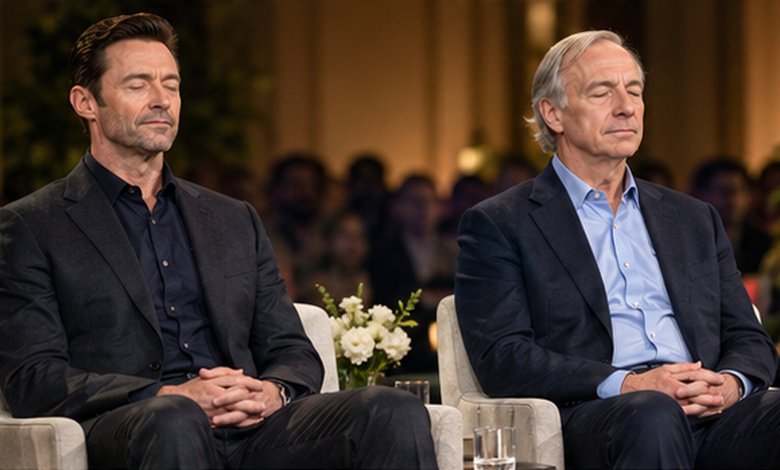
Discover what connects Hugh Jackman and Ray Dalio, from meditation and mental clarity to the habits behind success.
Hugh Jackman and Ray Dalio are connected through their shared interest in Transcendental Meditation (TM), a practice both have publicly praised for its role in personal well-being and mental clarity. Although they come from very different professional worlds, their association with meditation and the David Lynch Foundation reveals an unexpected common ground.
What could an award-winning Hollywood actor and one of the world’s most influential billionaire investors possibly have in common?
At first glance, Hugh Jackman and Ray Dalio seem to occupy entirely different worlds. One is known for bringing Wolverine to life, commanding Broadway stages, and starring in major films. The other built his reputation through financial markets, economic analysis, and a distinctive approach to decision-making.
Yet there is an interesting connection between them that goes beyond celebrity culture and business success.
Both have spoken positively about Transcendental Meditation, a technique associated with improved relaxation and mental stillness. Their connection also intersects with the work of the David Lynch Foundation, an organization that promotes meditation as a tool for supporting mental health and resilience.
This shared interest raises a fascinating question: What can an actor and an investor teach us about the importance of mental discipline?
To understand the connection, it helps to look beyond their public achievements and explore the personal practices that have influenced their lives.
What You'll Discover:
What Connects Hugh Jackman and Ray Dalio?
The strongest documented connection between Hugh Jackman and Ray Dalio is their shared involvement in the Transcendental Meditation community and the wider network surrounding the David Lynch Foundation.
Transcendental Meditation is commonly abbreviated as TM. It is a meditation technique involving the silent repetition of a personally assigned mantra, generally practiced for approximately 20 minutes twice daily.
Jackman has discussed his experience with the practice in interviews, while Dalio has publicly credited meditation with playing an important role in his personal and professional development.
Their connection is therefore better understood as a shared philosophy and involvement in a broader community rather than evidence of a close personal friendship or business partnership.
That distinction matters. The available documentation supports a meaningful common interest, but it does not establish that the two men regularly meet, collaborate professionally, or maintain a private relationship.
Their shared association with the David Lynch Foundation
David Lynch Foundation is an important part of this story.
Founded by filmmaker David Lynch, the organization supports programs that make meditation instruction available to people facing challenging circumstances, including veterans, students, and individuals experiencing significant stress.
Hugh Jackman and his former wife, Deborra-Lee Furness, received the foundation’s Lifetime of Giving Award at its fifth annual Change Begins Within gala in New York on December 3, 2013.
The foundation’s 2014 annual report also documents a separate intimate event featuring Ray Dalio and filmmaker Martin Scorsese. The event explored the role Transcendental Meditation had played in their respective journeys.
These records demonstrate that both men were connected to the same wider charitable and meditation community, although they do not establish that they attended the same event.
This is an important detail often lost when their names appear together online.
Hugh Jackman’s Relationship With Transcendental Meditation
How Hugh Jackman discovered meditation
Jackman’s interest in meditation began long before his international fame.
In a 2020 interview on The Tim Ferriss Show, he explained that he was introduced to meditation while attending drama school. He began practicing Transcendental Meditation at approximately 23 years old.
What makes his account particularly interesting is that he did not describe meditation as a way to become more productive or achieve celebrity status. Instead, he described it as a way to understand his thoughts and avoid becoming controlled by them.
He explained that the mind is naturally active, constantly generating thoughts, worries, and distractions. For him, meditation provides a way to step back from that activity rather than react automatically to everything happening around him.
Jackman compared the experience to pouring cloudy water into a glass and allowing the particles to settle until the water becomes clear.
That analogy captures the personal benefit he associates with the practice: a calmer mind, clearer intentions, and more purposeful listening.
How meditation fits into his daily routine
Jackman’s approach also demonstrates how meditation can become part of an ordinary routine rather than an isolated wellness activity.
During his 2020 interview, he described a morning ritual that included reading with his then-wife, Deborra-Lee Furness, before meditating together.
He explained that they often spent at least 30 minutes reading and then made time for meditation. The routine gave them an opportunity to connect before professional responsibilities and daily distractions took over.
He also revealed that he had practiced twice daily for many years, although he later became more flexible about his afternoon sessions.
An especially useful lesson from his experience is that consistency does not necessarily mean following a rigid schedule without considering personal circumstances.
For someone working long hours, a realistic meditation routine may be more sustainable than an ambitious plan that quickly becomes another source of pressure.
Jackman’s experience is documented in the full Tim Ferriss interview:
Ray Dalio’s Connection to Meditation and Mental Clarity
Why a billionaire investor values meditation
Ray Dalio approaches life through a different professional lens.
As the founder of Bridgewater Associates, he became known for studying economic patterns, examining mistakes, and developing systematic approaches to decision-making.
His philosophy emphasizes the importance of understanding reality rather than allowing personal preferences or emotions to distort judgment.
Meditation fits naturally into this broader interest in self-awareness.
Dalio has publicly praised Transcendental Meditation and endorsed Bob Roth’s book, Strength in Stillness.
In his endorsement, Dalio described Transcendental Meditation as the most important reason for his success and praised the book for explaining the practice.
That is a significant statement, particularly from someone whose professional life involves making decisions under uncertainty.
However, it is important to understand what his endorsement means. It represents his personal assessment of meditation’s importance, not scientific proof that meditation alone produces financial success.
The connection between meditation and decision-making
Investing requires more than understanding financial statements and economic indicators.
Investors must also manage uncertainty, recognize emotional reactions, and avoid making impulsive decisions when markets become unpredictable.
Imagine an investor watching a portfolio lose 15% of its value during a market downturn. Panic might encourage an immediate sale, even when the original investment strategy remains sound.
A calmer decision-making process allows the investor to examine the underlying facts before acting.
This is where Dalio’s interest in mental clarity becomes relevant.
His broader philosophy, particularly the ideas presented in his book Principles, encourages people to examine their mistakes, recognize weaknesses, and learn from uncomfortable experiences.
Meditation and systematic reflection are not identical practices, but they can support a similar objective: creating space between an initial reaction and a considered response.
A useful distinction: Meditation can help someone observe their thoughts, while a decision-making framework helps them evaluate what to do next.
Neither guarantees good decisions, but combining self-awareness with structured reasoning can be valuable.
What Ray Dalio’s endorsement of Bob Roth reveals
Bob Roth is a prominent meditation teacher and the chief executive of the David Lynch Foundation.
His book Strength in Stillness explains Transcendental Meditation in accessible language and includes endorsements from public figures who have experienced the technique.
Both Hugh Jackman and Ray Dalio have publicly expressed appreciation for Roth’s work.
Jackman has discussed his own meditation practice, while Dalio has specifically praised Roth’s book.
This creates another meaningful link between the two men: their interest is not simply in the general idea of relaxation but in a particular meditation tradition.
It also explains why their names sometimes appear together in discussions about meditation, personal development, and successful people.
Hugh Jackman and Ray Dalio: A Comparison
Although both men value meditation, their careers and public approaches to success are considerably different.
| Category | Hugh Jackman | Ray Dalio |
| Primary profession | Actor and performer | Investor and entrepreneur |
| Known for | Wolverine, Broadway, film and music | Bridgewater Associates and investment philosophy |
| Meditation interest | Personal well-being and mental clarity | Mental clarity and personal development |
| Public connection | David Lynch Foundation events and TM advocacy | TM endorsement and meditation-related events |
| Documented influence | Focus, emotional balance, daily routines | Self-awareness and decision-making |
| Notable resource | Tim Ferriss interview | Strength in Stillness endorsement |
The most interesting difference is how their experiences translate into everyday life.
Jackman discusses meditation in the context of performance, relationships, preparation, and emotional energy.
Dalio’s public philosophy places greater emphasis on reflection, recognizing mistakes, and making decisions based on reality.
Yet both illustrate an important principle: professional achievement and personal development do not have to be separate pursuits.
Did Hugh Jackman and Ray Dalio Ever Attend the Same Event?
This is one of the most interesting questions surrounding their connection.
The David Lynch Foundation’s historical records document separate appearances involving both individuals.
In December 2013, Hugh Jackman and Deborra-Lee Furness were honored at the foundation’s Change Begins Within gala in New York. They received the Lifetime of Giving Award for their involvement in the foundation’s charitable work.
The foundation’s 2014 annual report also describes an intimate gathering featuring Ray Dalio and filmmaker Martin Scorsese, where they discussed their personal journeys and the role meditation played in their lives.
These are documented connections to the same organization, but the available records do not establish that Jackman and Dalio attended that particular gathering together.
There is another important development worth mentioning.
In September 2024, Jackman hosted the David Lynch Foundation’s Meditate America benefit gala at Jazz at Lincoln Center in New York. The event featured an interview with Dr. Tony Nader and supported the foundation’s mental health and resilience campaign.
This demonstrates that Jackman’s involvement with the meditation community continued well beyond his original recognition by the foundation.
What Can We Learn From Their Shared Interest in Meditation?
The connection between Jackman and Dalio becomes more useful when we move beyond celebrity curiosity and consider the lessons their experiences offer.
Their professional lives are different, but several practical insights emerge.
1. Mental clarity deserves regular attention
Many people spend considerable time improving physical fitness, developing professional skills, and increasing their knowledge.
However, they rarely dedicate the same attention to understanding their thoughts.
Meditation offers one possible way to develop that awareness.
A person preparing for an important presentation, for example, may use a quiet meditation session to become less distracted by nervous thoughts.
The goal is not necessarily to eliminate anxiety. It is to avoid allowing anxiety to dictate every action.
2. Success requires more than talent
Jackman’s acting career demonstrates the importance of preparation, discipline, and emotional commitment.
Dalio’s investment philosophy highlights research, reflection, and the willingness to learn from mistakes.
Their shared interest in meditation adds another dimension: how people manage their internal experiences while pursuing demanding goals.
Talent may create opportunities, but sustainable performance often requires habits that support concentration and emotional resilience.
3. Self-awareness can improve everyday decisions
One of Dalio’s most recognizable ideas is the importance of confronting reality rather than protecting personal assumptions.
Jackman’s descriptions of meditation similarly emphasize becoming less reactive and more aware.
Consider a disagreement at work.
An immediate emotional response might damage a professional relationship. Taking time to recognize the emotion before responding can create an opportunity to communicate more thoughtfully.
This does not mean meditation automatically makes someone wise. It simply offers a potential tool for developing greater awareness.
4. Personal development does not have to look identical for everyone
Jackman and Dalio demonstrate that people can share a practice without having identical routines or motivations.
One may value meditation because it supports creative performance, while another may appreciate the opportunity for reflection.
Someone with a demanding office schedule might begin with five quiet minutes each morning rather than attempting a lengthy routine.
The important consideration is whether a practice is sustainable and genuinely useful.
What Exactly Is Transcendental Meditation?
Transcendental Meditation is a specific meditation technique developed and popularized by Maharishi Mahesh Yogi.
Unlike some mindfulness practices, which involve observing breathing, bodily sensations, or thoughts, TM uses a mantra that is silently repeated during meditation.
The standard practice involves:
- Sitting comfortably with the eyes closed.
- Silently repeating a personally assigned mantra.
- Allowing thoughts to come and go without deliberately fighting them.
- Practicing for approximately 20 minutes, generally twice daily.
The technique is traditionally taught through personal instruction by a certified TM teacher.
It is worth distinguishing the claims made by meditation organizations from established scientific findings. The US National Center for Complementary and Integrative Health (NCCIH) reports that meditation research suggests potential benefits for anxiety, depression, and other conditions, but also emphasizes that research quality and results vary.
Meditation should be considered a possible complement to appropriate healthcare, not a replacement for professional treatment.
Common Misconceptions About Hugh Jackman and Ray Dalio
Several assumptions can develop when two famous individuals are discussed together. Separating documented information from speculation makes their connection much easier to understand.
Misconception 1: They are business partners.
There is no reliable public evidence establishing a business partnership between Jackman and Dalio.
Misconception 2: They are close personal friends.
Their shared meditation interests and connections to the David Lynch Foundation do not independently establish a close friendship.
Misconception 3: They practice exactly the same daily routine.
Both have publicly supported Transcendental Meditation, but their individual routines and experiences should not be treated as identical.
Misconception 4: Meditation explains all their professional success.
Both men have achieved success through years of work, talent, preparation, and decision-making. Their personal endorsements of meditation should not be interpreted as proof that the practice caused their achievements.
Misconception 5: Transcendental Meditation and mindfulness are interchangeable.
They are different approaches. TM uses a mantra, whereas mindfulness practices commonly emphasize awareness of present experiences.
Frequently Asked Questions
1. What is the connection between Hugh Jackman and Ray Dalio?
Hugh Jackman and Ray Dalio share an interest in Transcendental Meditation and have connections to the David Lynch Foundation. Both have publicly expressed appreciation for meditation.
2. Does Hugh Jackman practice Transcendental Meditation?
Yes. Jackman has discussed practicing Transcendental Meditation since his drama school days. In a 2020 interview, he described beginning the practice at approximately 23 years old.
3. Does Ray Dalio believe meditation contributed to his success?
Yes. Dalio has publicly credited Transcendental Meditation as an important influence on his life and endorsed Bob Roth’s book Strength in Stillness.
4. Are Hugh Jackman and Ray Dalio friends?
Their shared interests and association with the David Lynch Foundation are documented. However, there is insufficient reliable public evidence to establish that they have a close personal friendship.
5. What is the David Lynch Foundation’s role in their connection?
The David Lynch Foundation promotes meditation programs and supports initiatives involving mental health and resilience. Jackman has participated in its fundraising activities, while Dalio has appeared at foundation-related events discussing meditation.
Key Takeaways
- Hugh Jackman and Ray Dalio are connected through their shared interest in Transcendental Meditation.
- Jackman began practicing meditation during drama school and has discussed its importance for mental clarity and emotional balance.
- Dalio has publicly credited meditation as an important influence on his personal and professional life.
- Both men have connections to the David Lynch Foundation, which supports meditation initiatives.
- Jackman received the foundation’s Lifetime of Giving Award with Deborra-Lee Furness in 2013.
- Their experiences demonstrate different ways meditation can fit into demanding professional lives.
- There is no established evidence that they are business partners or close personal friends.