Concussion eye test with flashlight: learn what pupil reactions mean, what they cannot prove, and when head injury needs urgent care.
A concussion eye test with flashlight checks how the pupils respond to light, but it cannot diagnose a concussion by itself. Unequal, fixed, or unusually sluggish pupils after a head injury can signal a more serious problem and warrant urgent medical assessment, particularly when accompanied by worsening headache, vomiting, confusion, weakness, seizures, or vision changes.
What You'll Discover:
Why People Check the Eyes After a Head Injury
A flashlight is one of the simplest tools for observing the nervous system. When light enters the eye, a reflex pathway involving the optic nerve, midbrain and oculomotor nerve causes the pupil to constrict, so an abnormal response can provide an important neurological clue.
That explains why parents, coaches and first-aid providers sometimes look at the pupils after someone hits their head. The important catch is that a pupil check is one observation, not a concussion diagnosis.
A concussion is a type of traumatic brain injury, and its effects can involve thinking, balance, vision, mood, sleep and physical symptoms. The symptoms may appear immediately or evolve over hours or days, so normal-looking pupils do not rule out concussion.
A normal pupil reaction does not rule out a concussion.
That distinction is the biggest thing many quick online explanations miss.
What the Concussion Eye Test With Flashlight Checks
The pupil light reflex
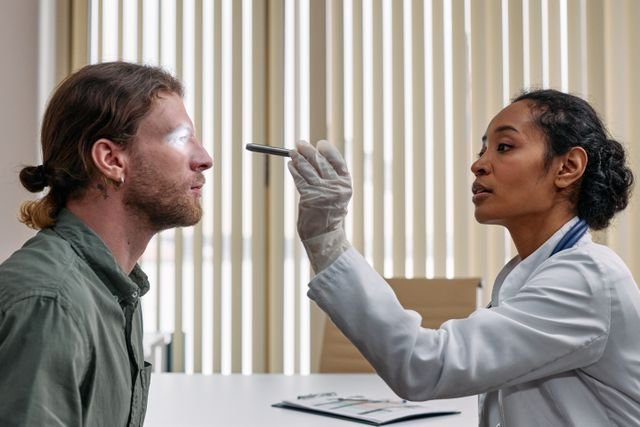
In a typical response, shining light into one eye causes that pupil to become smaller. The opposite pupil should also constrict because the reflex is coordinated between both eyes. Clinicians may assess both the direct and consensual responses.
A clinician can also perform a more specialized swinging flashlight test. The light is moved from one eye to the other while the examiner watches for differences in the response. This can help identify a relative afferent pupillary defect, sometimes called a Marcus Gunn pupil, which points toward an abnormality in the optic nerve or retina rather than simply proving that someone has a concussion.
What a normal response generally looks like
The pupils should generally be similar in size and round in shape, with a prompt constriction when exposed to light. However, small differences in pupil size can occur naturally, so simply seeing slightly unequal pupils does not automatically mean there is a brain injury.
This is where home testing becomes tricky: judging pupil size and speed by eye is considerably less precise than a trained neurological examination.
What an abnormal response may mean
A markedly unequal pupil, a pupil that does not react normally, or a new abnormal eye finding after head trauma can be concerning. These findings may occur with serious neurological or eye problems, including conditions involving increased intracranial pressure or damage to structures controlling the pupil.
The key word is may.
An abnormal pupil response does not tell you exactly what happened, which is why it should trigger appropriate medical evaluation rather than a home diagnosis.
How to Check Pupil Response Safely
If you are observing someone after a head injury, the priority is not to perform a perfect flashlight examination. It is to recognize concerning changes and decide whether medical help is needed.
If the person is awake, cooperative and otherwise stable, you can observe the pupils without repeatedly shining a bright light directly into the eyes.
A basic observation
- Look at both pupils before using a light and note whether one is obviously larger than the other.
- Ask the person to look at a distant object rather than directly at the flashlight.
- Use a small light from the side rather than placing an intense beam directly against the eye.
- Briefly illuminate one eye and observe whether the pupil constricts.
- Compare the response between the two eyes.
- Stop if the person develops significant discomfort, headache, nausea or other worsening symptoms.
Clinical pupillary examinations use controlled technique and positioning, and a professional may perform additional tests that cannot be interpreted reliably at home.
Do not repeatedly test the pupils in an attempt to decide whether someone is “safe.” If serious symptoms are present, seeking medical care matters far more than obtaining another flashlight observation.
What the Flashlight Test Cannot Tell You
This is the crucial limitation.
A pupil test does not establish whether a person has a concussion. Concussion assessment is multimodal: clinicians consider the injury mechanism, symptoms, neurological findings, balance, cognition and other relevant domains rather than relying on a single sign. The international concussion consensus specifically recommends a multimodal evaluation rather than a single test.
For example, someone can have a concussion with:
- Headache
- Dizziness
- Light or noise sensitivity
- Brain fog
- Memory problems
- Nausea
- Balance problems
- Fatigue
- Blurred or double vision
- Difficulty concentrating
while having pupils that appear completely normal.
Conversely, an abnormal pupil finding can reflect a problem other than concussion.
The flashlight test is a neurological clue, not a concussion clearance test.
That distinction prevents two common mistakes: false reassurance after a normal pupil check and unnecessary confidence after an abnormal one.
Flashlight Test vs. Professional Concussion Assessment
| Assessment | What it examines | Can diagnose concussion alone? | Main value |
| Pupil light response | Pupillary reflex and symmetry | No | Identifies potentially concerning neurological findings |
| Symptom assessment | Headache, dizziness, cognition and other symptoms | No | Establishes the person’s clinical picture |
| Neurological examination | Cranial nerves, strength, sensation, coordination and more | No single component | Looks for neurological abnormalities |
| VOMS | Eye movements and vestibular/ocular symptoms | No | Screens several visual and vestibular functions |
| SCAT6/SCOAT6 | Multidomain concussion assessment | Used as part of clinical assessment | Structured evaluation and monitoring |
The Vestibular/Ocular Motor Screening (VOMS) is particularly different from a flashlight check. It examines smooth pursuit, saccades, near-point convergence, vestibulo-ocular reflex and visual-motion sensitivity. Research suggests that these components can identify ocular and vestibular symptoms that a simple pupil examination would miss.
In one preliminary VOMS study, 61% of patients with sport-related concussion reported symptom provocation during at least one VOMS item. Later research in collegiate athletes found that the overall VOMS score had strong discriminative performance, reinforcing its role as one component of a broader assessment.
When an Abnormal Pupil Finding Is an Emergency
After a head injury, do not wait for a home flashlight test to “confirm” danger signs.
The CDC advises emergency evaluation for signs including a worsening headache, repeated vomiting, seizures, increasing confusion or agitation, difficulty waking, weakness or numbness, slurred speech, decreased coordination, one pupil being larger than the other, or double vision.
Mayo Clinic similarly lists unequal pupils and other eye or vision changes among reasons to seek emergency care following a head injury.
If these symptoms occur, the practical decision is straightforward: seek emergency medical care rather than continuing to test the eyes at home.
Common Misconceptions About Pupil Checks
“If the pupils are equal, there is no concussion.”
False. Equal pupils are reassuring in a narrow sense, but concussion can affect many brain functions without producing an obvious pupil abnormality.
“Unequal pupils always mean a concussion.”
Also false. Some people naturally have a small difference in pupil size, known as physiologic anisocoria. Other eye, optic-nerve or neurological conditions can also produce unequal pupils.
“A flashlight can tell how severe the concussion is.”
Not reliably. Pupil abnormalities can be associated with serious neurological injury, but the flashlight observation cannot grade the severity of a concussion.
“You should keep testing the pupils overnight.”
There is no reason to turn pupil checks into a repetitive home monitoring ritual. After a head injury, follow professional instructions and monitor for evolving symptoms; CDC guidance notes that some concussion signs and symptoms may not appear or be noticed until hours or days later.
What to Do After a Suspected Concussion
If someone has had a bump, blow or jolt and develops possible concussion symptoms, remove them from sports or other risky activity and arrange appropriate medical evaluation.
For athletes, CDC guidance says a suspected concussion should result in removal from sports participation, with no same-day return until the athlete has been evaluated and cleared by a healthcare provider.
A flashlight test can be useful as an observation, but it should never become the reason someone returns to play.
For symptoms that persist beyond the acute period, the Amsterdam consensus recommends a multimodal clinical assessment. Persistent symptoms can involve visual, oculomotor, vestibular, headache, sleep, psychological and other factors, so the right evaluation may involve more than one type of healthcare professional.
Frequently Asked Questions
Can you test for a concussion with a flashlight?
No. A flashlight can assess the pupil light reflex, but it cannot diagnose or rule out concussion. Concussion requires consideration of symptoms, signs, neurological findings and other clinical information.
What should pupils do after a light is shined into the eye?
Normally, the illuminated pupil constricts and the opposite pupil also constricts. Clinicians assess these direct and consensual responses as part of a broader eye and neurological examination.
What does it mean if one pupil is bigger after a head injury?
A newly unequal pupil after head trauma can be a warning sign of a serious injury, particularly when accompanied by other neurological or visual symptoms. Emergency evaluation is appropriate when this occurs after a head injury.
Can you have a concussion if the pupils look normal?
Yes. Concussion does not require abnormal pupils. Visual, cognitive, balance, physical and emotional symptoms can occur even when the pupils appear normal.
Is a phone flashlight safe for checking pupils?
A phone flashlight can provide illumination, but home observation is not equivalent to a professional pupillary examination. Avoid prolonged or unnecessarily intense light exposure and seek medical care when concerning symptoms are present.
Key Takeaways
- A concussion eye test with flashlight checks the pupil light reflex; it does not diagnose concussion.
- Equal, reactive pupils do not rule out a concussion.
- A new markedly unequal, fixed or abnormal pupil after head trauma can be an emergency warning sign.
- The flashlight test cannot determine how severe a concussion is.
- Professional concussion assessment is multimodal, incorporating symptoms, neurological findings, cognition, balance and other relevant systems.
- VOMS can reveal vestibular and ocular-motor problems that a simple pupil test cannot detect.
- After a suspected concussion, worsening headache, repeated vomiting, seizures, confusion, weakness, difficulty waking, slurred speech, poor coordination, unequal pupils or double vision warrant urgent medical attention.