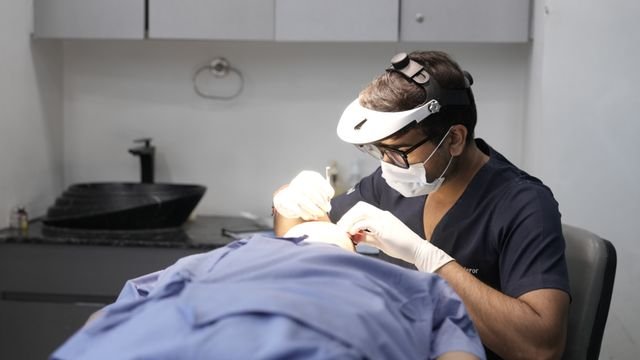
Fibroblast before and after results explained: see realistic changes, healing stages, risks, and what affects your outcome.
Fibroblast before and after photos can show tighter-looking skin, softer fine lines, and improved texture, but results vary considerably. Plasma fibroblast treatments deliberately create controlled skin injury, so early photos can look worse before the skin settles; final results should be judged after healing, not immediately after treatment.
A fibroblast before and after photo can be surprisingly persuasive. One image shows loose or crepey skin; the next appears smoother, tighter, and more lifted. But there is a detail that is easy to miss when scrolling through polished treatment galleries: the “after” photo may represent a very specific point in a much longer healing process.
That matters because plasma fibroblast treatment is not simply a beauty treatment that makes skin instantly tighter. A plasma pen creates tiny areas of thermal injury on the skin, triggering a wound-healing response. The resulting redness, swelling, crusting, pigment changes, and gradual remodeling can dramatically change how the skin looks from day to day.
So what should a convincing fibroblast before and after actually look like? And how can you tell a meaningful result from lighting, makeup, camera angle, or temporary swelling?
The answers are more nuanced than most before-and-after galleries suggest.
What You'll Discover:
What Does Fibroblast Treatment Actually Do?
“Fibroblast” treatment usually refers to plasma fibroblast therapy, also called fibroblasting or plasma pen treatment. A handheld device delivers plasma energy close to the skin surface, producing small points of thermal injury intended to stimulate a healing response and alter the appearance of lax or wrinkled skin.
The name can be confusing. Fibroblasts are cells in connective tissue; they are not the treatment itself. These cells participate in producing extracellular-matrix components, including collagen, during wound healing.
That is why providers often describe the treatment as “stimulating fibroblasts.” However, marketing language can make the biology sound more certain and dramatic than the available clinical evidence supports.
The treatment is also not the same thing as an injectable fibroblast therapy or cultured-fibroblast filler. Those are separate procedures with different mechanisms and evidence.
A before-and-after photograph shows an appearance, not proof of how that appearance was produced.
What Can You See in Fibroblast Before and After Photos?
The most commonly advertised changes involve mild skin laxity, fine lines, crepey texture, and selected areas around the eyes or mouth. Some providers also use plasma devices for scars and other cosmetic concerns, although the evidence and regulatory status can differ by device and indication.
Upper eyelids and hooded-looking skin
Upper-eyelid photographs are among the most common examples because even a modest change in the position or tightness of thin eyelid skin can be visually noticeable.
A successful treatment may make the upper eyelid look less crepey or slightly more open. But it should not be interpreted as equivalent to removing excess skin during blepharoplasty.
The American Academy of Dermatology notes that surgical lifts generally produce the most dramatic tightening, while nonsurgical approaches tend to provide less pronounced results.
Fine lines and wrinkles
Before-and-after images may show softer crow’s-feet or fine lines around the mouth.
The important word is softer. Expecting every wrinkle to disappear is unrealistic, particularly when wrinkles are caused by repeated muscle movement, significant sun damage, or deeper structural changes.
Crepey skin
Crepey skin can sometimes appear smoother after treatment because the surface and underlying tissue undergo healing and remodeling.
But photography can exaggerate this improvement. A slightly different expression, moisturizer, lighting direction, or camera distance can make fine texture look dramatically different.
Acne scars and uneven texture
Some clinics promote plasma fibroblast treatment for acne scars. Yet scar treatment is especially dependent on the type of scar involved.
An ice-pick scar, rolling scar, and boxcar scar do not respond identically to cosmetic procedures. A photograph showing improvement in one scar type should not be treated as evidence that the treatment will produce the same result for every scar.
The Healing Timeline Matters More Than the “After” Photo
One of the biggest mistakes people make is comparing the wrong stages.
Immediately after plasma treatment, the skin can be red and swollen, with visible treatment points. Tiny crusts or scabs can develop and later shed. Health Canada has specifically warned about possible redness, swelling, peeling, crusting, pigmentation changes, burns, scarring, and infection associated with plasma pens.
A simplified timeline looks like this:
| Stage | What you may see | What it means |
| Immediately after | Redness, swelling, visible treatment points | The skin has just been injured |
| First several days | Crusting, darker spots, irritation | Early wound healing |
| Around 1 week | Crusts may begin shedding | Surface recovery is progressing |
| Following weeks | Pinkness or uneven pigmentation may remain | Deeper healing continues |
| Several weeks to months | Texture and firmness may gradually settle | A more useful point for judging the result |
The exact timeline varies with the device, treatment intensity, body area, skin type, aftercare, and individual healing.
The first few days are a healing phase, not a reliable “final result.”
This is why a website showing only an immediate post-treatment photograph can be misleading. A genuinely useful comparison should show a healed follow-up at a meaningful interval.
What Makes a Before-and-After Photo Trustworthy?
A good photograph is not necessarily a good piece of evidence.
When assessing fibroblast before and after results, look for consistency in five areas.
Same lighting
Light coming from above can emphasize texture and shadows. Frontal lighting can make the same skin appear considerably smoother.
The most useful comparisons use similar lighting conditions.
Same camera angle
A slightly raised camera can change how eyelid skin, jawline laxity, and neck contours appear.
Ideally, the face or treatment area should be positioned similarly in both images.
Same expression
A smiling face and a relaxed face are not equivalent comparisons. This is especially important around the eyes and mouth, where muscle movement changes wrinkles.
No makeup or filters
Foundation can conceal redness, pigmentation, and texture. Filters can alter skin tone and smooth details even more dramatically.
Look for photographs identified as unretouched and taken under comparable conditions.
Enough follow-up time
An image taken immediately after treatment can show swelling or temporary tightening. It tells you much less about the eventual result than a properly healed follow-up.
Real-world examples illustrate why patience matters. One published personal account documented limited perceived improvement at four weeks and no meaningful improvement reported by the author at 12 weeks. That is only one person’s experience, not clinical evidence, but it is a useful reminder that an attractive treatment theory does not guarantee a noticeable personal result.
Fibroblast Before and After: What Results Are Realistic?
The most realistic expectation is modest improvement rather than a surgical transformation.
If someone has a small amount of laxity and mainly wants slightly firmer-looking skin, the difference may be worthwhile. Someone with substantial excess skin may be disappointed if they expect a plasma pen to replicate an eyelid lift, facelift, or neck lift.
The American Academy of Dermatology similarly distinguishes between nonsurgical treatments that offer modest tightening and surgical procedures that provide more dramatic lifting.
| Goal | Fibroblast may be considered | Expectations to keep in mind |
| Mild crepey skin | Potentially | Improvement may be subtle |
| Fine lines | Potentially | Not every wrinkle responds equally |
| Mild laxity | Potentially | Not comparable with surgery |
| Significant excess skin | Usually a poor match | Surgery may be more appropriate |
| Deep acne scars | Depends on scar type | Other scar treatments may be better studied |
| Major facial lifting | Poor match | A nonsurgical procedure has clear limits |
This distinction is one of the most important things to understand before looking at dramatic online galleries.
What Can Go Wrong?
The attractive side of fibroblast before and after photography is easy to find. The less glamorous part deserves equal attention.
Potential complications include burns, prolonged redness, swelling, changes in skin pigmentation, infection, and scarring. The risk may increase when treatment is too aggressive or performed by someone without appropriate training.
Pigment changes deserve particular attention for people prone to post-inflammatory hyperpigmentation. A treatment that produces a small improvement in texture but leaves persistent dark or light marks may not feel like a successful cosmetic result.
The location also matters. Treatment near the eyes requires particular care. A published case report described bilateral chemical eye injury after topical anesthetic used during a plasma fibroblast procedure accidentally contacted the eyes.
Why the device matters
“Plasma” is not one standardized technology.
Different devices can use different energy sources, operating parameters, treatment depths, and intended indications. An FDA warning letter concerning a specific manufacturer illustrates this distinction: the agency described products marketed as “Plasma MD” and “Plasma +” and questioned regulatory compliance surrounding their medical-device claims.
That should not be turned into the claim that every plasma device is identical, or that every device is automatically unsafe. It means consumers should identify the exact device and its regulatory status in their jurisdiction, rather than relying on the generic word “fibroblast.”
Is Fibroblast Better Than Other Skin-Tightening Treatments?
Not automatically.
The best option depends on whether the main problem is loose skin, wrinkles, pigmentation, acne scarring, volume loss, or a combination of several issues.
For example, the AAD describes ultrasound, radiofrequency, lasers, minimally invasive procedures, and surgery as different approaches to skin tightening, each with different levels of downtime and expected results.
Microneedling is another important comparison because it also uses controlled injury to encourage collagen production. The AAD notes that dermatologists use microneedling for wrinkles, acne scars, uneven texture, and some forms of sagging skin, and that radiofrequency microneedling adds heat beneath the skin.
The smarter question is therefore not “Does fibroblast work?”
It is:
“Is this particular treatment the best risk-to-benefit match for my specific problem?”
Who Should Be Especially Careful?
A consultation is particularly important if you have significant skin laxity, a history of abnormal scarring, pigmentation concerns, active skin problems, or uncertainty about what device will be used.
The AAD recommends discussing your health, medications, skin condition, desired outcome, alternatives, and the provider’s experience before undergoing a cosmetic procedure.
Ask these questions before agreeing to treatment:
- What exact device will be used?
- What is the device authorized or cleared to do in my country?
- Who will perform the treatment, and what training do they have?
- How many patients with my skin tone have they treated?
- What complications have they personally seen?
- What should my skin look like during healing?
- What happens if I develop pigmentation, burns, or scarring?
- What alternatives would give me a better result?
If the provider cannot answer these questions clearly, that is useful information in itself.
Can You Do Fibroblast Treatment at Home?
This is one area where caution is warranted.
Commercial plasma pens are available online, but the existence of a device for sale does not establish that it is safe or appropriate for self-treatment. A published analysis of TikTok fibroblast-pen content found that many commercially sold pens were not FDA-regulated and identified potential risks including dyspigmentation, scarring, and mechanical burns.
Health Canada has likewise warned about plasma pens sold or used outside appropriate medical oversight, citing risks that include burns, scarring, infection, pigmentation changes, and eye injury.
The face is not the place to experiment with an unknown electrical device because an error can become a permanent scar.
How to Judge Your Own Result Fairly
If you have already had treatment, resist the urge to evaluate the result every morning in a different mirror.
Instead, take standardized photographs: same room, same lighting, same camera, same distance, neutral expression, and no makeup. Keep the original photographs rather than relying on memory, because gradual changes are surprisingly difficult to judge subjectively.
Then compare photographs at the follow-up point recommended by your qualified provider.
Most importantly, distinguish between skin healing and skin tightening. Redness disappearing is not the same thing as collagen remodeling, and swelling going down is not proof that the treatment has permanently tightened the skin.
If you develop worsening pain, spreading redness, significant swelling, pus, severe blistering, vision symptoms, or other concerning changes, seek medical attention rather than waiting for the cosmetic result to improve.
Frequently Asked Questions
How long does it take to see fibroblast results?
Some visible changes can occur during early healing, but the final appearance should not be judged immediately. Skin remodeling continues after the surface has healed, and the timing varies by treatment and individual.
How long do fibroblast results last?
There is no single guaranteed duration. Aging, sun exposure, weight changes, skin quality, treatment technique, and the original degree of laxity can all affect how long an improvement remains noticeable.
Does fibroblast treatment remove loose skin?
It may improve the appearance of mild laxity, but it does not remove excess skin. Significant loose skin is generally a different problem from mild crepiness or fine lines.
Is fibroblast treatment safe?
Safety depends on the exact device, treatment technique, provider, treatment area, and regulatory setting. Reported complications include burns, pigmentation changes, infection, scarring, and other injuries, so appropriate professional assessment matters.
Are fibroblast before and after photos reliable?
They can be useful, but only when photographs are genuinely comparable. Matching lighting, camera angle, expression, makeup, and follow-up timing makes a comparison much more meaningful.
Key Takeaways
- Fibroblast before and after photos can show improvement, but they do not guarantee the same result for everyone.
- Plasma fibroblast treatment creates controlled thermal injury intended to trigger a healing and remodeling response.
- Early redness, swelling, crusting, and pigmentation changes are part of the recovery process and should not be confused with the final result.
- The most convincing before-and-after photographs use comparable lighting, angles, expressions, and follow-up intervals.
- Fibroblast treatment is better suited to mild laxity and selected texture concerns than significant excess skin.
- Risks can include burns, pigmentation changes, infection, and scarring, particularly when treatment is poorly performed.
- The word “plasma” does not identify one standardized device, so always ask what exact technology is being used and what its regulatory status is.
- A qualified dermatologist or appropriately trained medical professional can help determine whether fibroblast treatment, or another procedure, actually fits your goal.
Additional Resources
- Many ways to firm sagging skin: A practical overview of surgical and nonsurgical tightening options, expected results, downtime, candidacy, and why professional assessment matters.