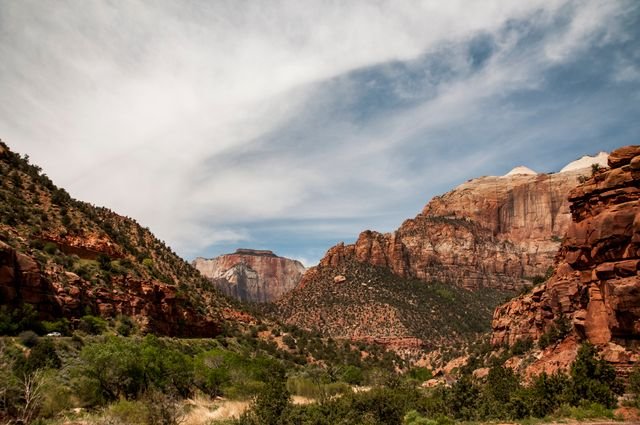
West Rim Trail Zion guide: route, camps, water, permits and safety tips for an unforgettable Zion hike.
The West Rim Trail Zion is a strenuous point-to-point route connecting the West Rim Trailhead near Lava Point with The Grotto in Zion Canyon. The National Park Service lists the route at 14.2 miles via the Rim Trail, with about 3,400 feet of elevation change, and nine designated backpacking sites.
Most hikers tackle it from Lava Point toward The Grotto because the overall direction is downhill, although the route still includes substantial climbing. A wilderness permit is required for overnight backpacking, while hiking from The Grotto to Scout Lookout on the West Rim Trail does not require an Angels Landing permit unless you continue onto the Angels Landing spur.
What You'll Discover:
Why the West Rim Trail Is Worth Your Time
There is an interesting moment on the West Rim Trail when Zion stops looking like the Zion most visitors know.
Instead of standing beneath towering sandstone walls in the main canyon, you are suddenly walking across high country, through forests and open plateau, with enormous canyons dropping away around you. The route eventually reconnects with the famous lower West Rim near Scout Lookout, but much of the journey feels remarkably removed from the busiest parts of the park.
That contrast is the real attraction. You get a taste of Zion’s high-elevation landscape, sweeping canyon views, quieter trail miles and, toward the end, the dramatic descent into Zion Canyon.
It is also one of those trails where choosing the wrong logistics can overshadow an otherwise fantastic hike.
West Rim Trail Zion at a Glance
| Detail | What to expect |
| Location | Zion National Park, Utah |
| Route | West Rim Trailhead near Lava Point to The Grotto |
| Official distance | 14.2 miles via Rim Trail; 13.6 via Telephone Canyon shortcut |
| Elevation change | About 3,400 feet |
| Difficulty | Strenuous |
| Trail type | Point-to-point |
| Backpacking | Yes, with designated campsites |
| Overnight permit | Required |
| Main water sources | Sawmill Springs, Potato Hollow Spring, Cabin Spring |
| Typical season | Late spring, summer and fall |
| Major logistical issue | Arranging transportation between trailheads |
The distance is worth clarifying because published hiking guides sometimes report substantially different numbers. GPS-based trip reports can produce longer figures depending on exactly where the route begins and ends, while the NPS trail description gives the official trail distances above. For planning, use the NPS figure and then allow extra mileage for trailhead access, campsite spurs and navigation.
The West Rim Trail changes character dramatically as it moves from high plateau to canyon.
Where the West Rim Trail Starts and Ends
The full route begins at the West Rim Trailhead near Lava Point on Kolob Terrace Road and finishes at The Grotto in Zion Canyon. That makes it a point-to-point hike rather than a conventional loop.
For most backpackers, this creates a simple strategic choice: arrange transportation to Lava Point, hike toward Zion Canyon, and finish where the park shuttle can eventually take you back toward the Visitor Center.
The reverse direction is possible, but it turns the route into a much more demanding uphill journey. From the Cabin Spring area, the trail drops approximately 2,500 feet over the final 4.7 miles toward The Grotto when traveling south, so hiking in the opposite direction means earning that elevation instead of giving it away.
Why Most People Go Top to Bottom
Starting at Lava Point makes intuitive sense for a long hike.
You begin around the high plateau and generally lose elevation as you work toward Zion Canyon, although the trail has several significant climbs along the way. The final descent is steep, but the psychological advantage of knowing that the route’s overall elevation trend is downward can be substantial after a long day.
There is another benefit: you finish at The Grotto rather than at a remote road on Kolob Terrace.
What the Route Is Actually Like
The first section feels more like a high-country hike than a classic Zion canyon walk. The trail crosses elevated terrain with views toward Wildcat Canyon before reaching Potato Hollow, and the landscape gradually changes as you approach the rim.
After the Telephone Canyon junction, the West Rim becomes increasingly dramatic. You follow the rim with views toward Phantom Valley and the canyon systems below before eventually reaching Cabin Spring and beginning the major descent toward Zion Canyon.
The final portion is where the landscape becomes unmistakably Zion.
You descend toward the canyon, pass through the rugged terrain around Behunin Canyon and Refrigerator Canyon, and eventually reach Scout Lookout. From there, the West Rim Trail continues down toward The Grotto.
That means the trail effectively gives you two experiences in one: a quieter high-country journey followed by a dramatic canyon finish.
How Difficult Is the West Rim Trail?
The West Rim Trail is best treated as a strenuous hike, particularly when completed in one day with a full pack.
The biggest mistake is looking only at the net elevation change. A route that loses 3,400 feet overall can still contain plenty of uphill hiking, and the NPS specifically describes the trail as having substantial elevation changes and a steep final descent.
Fitness matters, but so does pacing.
A strong hiker carrying a light daypack may find the top-down route manageable as a very long day. A backpacker carrying several days of food and equipment should expect the same trail to feel substantially harder.
Who Should Consider the Full Route?
The full hike makes sense if you are comfortable spending most of a day on your feet, can manage sustained elevation changes and have experience planning water and transportation in remote terrain.
If that description sounds ambitious rather than exciting, there is a simpler option: hike the West Rim Trail from The Grotto to Scout Lookout and return. That section gives you access to one of Zion’s most spectacular viewpoints without committing to the entire point-to-point route.
West Rim Trail and Angels Landing Are Not the Same Hike
This causes a surprising amount of confusion.
The West Rim Trail leads to Scout Lookout, where the Angels Landing Trail branches away. Hiking the West Rim from The Grotto to Scout Lookout does not require an Angels Landing permit. If you continue onto Angels Landing, however, a permit is required.
That distinction matters when planning a day hike.
A permit is required for Angels Landing, but not for hiking the West Rim Trail to Scout Lookout.
Angels Landing itself adds a much more exposed experience, including narrow sections, chains and significant drop-offs. The National Park Service describes the route as rocky and less than three feet wide in places, with traffic moving in both directions.
In other words, reaching Scout Lookout and deciding not to continue is a perfectly legitimate West Rim hiking objective.
Backpacking and Campsites
For an overnight trip, planning the campsite is just as important as planning the mileage.
The West Rim has nine designated backpacking sites, and camping is restricted to designated locations. Some sites are available through advance reservations while others are first-come, first-served.
A wilderness permit is mandatory for overnight backpacking. Current NPS guidance says permits must be obtained in person at the Zion Canyon Visitor Center Wilderness Desk, either the day before or the day of the trip.
How to Think About Campsite Selection
Do not choose a campsite solely because its mileage looks convenient.
Water availability, elevation, weather, daylight and your group’s pace can all change the ideal stopping point. A campsite that looks perfect on a map may become awkward if you arrive late, particularly when you still need to collect and treat water.
The park also limits camping near springs and other sensitive areas. Current regulations prohibit camping within one-quarter mile of a spring, among other restrictions.
Water: The Part You Should Not Improvise
Water deserves serious attention on the West Rim.
The NPS identifies Sawmill Springs, Potato Hollow Spring and Cabin Spring as water sources along the route and notes that seasonal conditions can affect availability.
That means you should never assume a spring will be flowing simply because an older trip report says it was.
Before leaving, check current conditions and ask the Wilderness Desk about water sources. Carry enough capacity to bridge unreliable stretches rather than building your entire plan around one spring.
And do not confuse Zion’s springs with the Virgin River. The park currently warns visitors not to drink from or submerge their heads in Zion’s rivers because of toxic cyanobacteria concerns.
When Is the Best Time to Hike?
The NPS lists the West Rim’s main hiking season as late spring, summer and fall. Winter can bring deep snow to the upper route, and snow can also make the road to the trailhead inaccessible.
Late spring and fall can offer a particularly appealing balance of cooler temperatures and more comfortable hiking conditions, but conditions can vary considerably by elevation.
Summer requires more attention to heat, hydration and afternoon weather. The high country may feel dramatically cooler than the canyon floor, so a backpacker should think in terms of changing conditions rather than assuming Zion equals one uniform desert climate.
Transportation and Shuttle Logistics
This is where a beautiful itinerary can become a bad one.
The West Rim Trail is not a loop, so you need a plan for reaching Lava Point and getting away from The Grotto. Commercial shuttle services are authorized to serve the West Rim via Lava Point, which gives backpackers another option besides arranging their own vehicle logistics.
Once you reach The Grotto, the Zion Canyon shuttle is the straightforward way to continue through the canyon during the operating season.
For 2026, the Zion Canyon shuttle resumed March 7, with seasonal schedules changing throughout the year. The National Park Service emphasizes that schedules can change, so check the current timetable before hiking rather than relying on a screenshot or old itinerary.
The West Rim is a point-to-point hike; transportation is part of the route, not an afterthought.
Common Mistakes to Avoid
Treating the trail as one long downhill
The overall route may descend, but there are meaningful climbs along the plateau and intermediate sections. Save energy early rather than assuming gravity will do all the work.
Carrying too little water
Seasonal springs are not guaranteed to behave exactly as expected. Verify current conditions and carry enough capacity for the gaps between sources.
Confusing Scout Lookout with Angels Landing
Scout Lookout is on the West Rim Trail. Angels Landing is a separate spur requiring its own permit.
Ignoring road conditions
Lava Point sits on Kolob Terrace Road, where snow and changing weather can affect access. The NPS specifically warns that the West Rim trailhead may be inaccessible during winter.
Planning only for the hiking time
A 14-mile route is not simply “14 miles of walking.” Trailhead transfers, shuttle timing, water collection, breaks, navigation and changing weather all belong in the itinerary.
West Rim Trail vs. an Angels Landing Day Hike
| Consideration | Full West Rim Trail | West Rim to Scout Lookout |
| Typical purpose | Backpacking or long day hike | Day hike |
| Starting point | Lava Point | The Grotto |
| Ending point | The Grotto | The Grotto |
| Transportation | Requires point-to-point planning | Park shuttle access |
| Overnight permit | Required if backpacking | Not required |
| Angels Landing permit | Only if adding Angels Landing | Required only if continuing to Angels Landing |
| Experience | High country + canyon | Canyon + Scout Lookout |
| Commitment | High | Moderate to strenuous |
For a first visit to Zion, the shorter option can be the smarter choice if your priority is experiencing the iconic canyon rather than completing a long backcountry route.
For experienced hikers, the full West Rim offers something the famous attractions cannot: time and distance away from the concentrated crowds.
A Practical Packing Strategy
Think lightweight, but not minimalist to the point of gambling with conditions.
For a full-day hike, prioritize adequate water capacity, food with enough calories for a long effort, sun protection, layers, navigation, a headlamp and basic emergency supplies. Backpackers should add a properly planned shelter, sleeping system, cooking setup where appropriate, waste-management supplies and all equipment required by their permit and current park regulations.
A downloaded offline map is particularly sensible because remote terrain and limited connectivity are poor combinations when you are trying to solve a navigation problem late in the day.
Most importantly, pack according to the season and current conditions rather than according to a generic Zion checklist.
Is the West Rim Trail Right for You?
If you want the shortest route to Zion’s famous scenery, probably not.
If you want to understand the park beyond the crowded canyon floor, however, the West Rim is compelling. It gives you changing ecosystems, broad high-country views, dramatic sandstone formations and a memorable descent into the heart of Zion.
The best way to approach it is not as a badge of endurance but as a route that rewards careful planning.
FAQs
How long is the West Rim Trail in Zion?
The National Park Service lists 14.2 miles from the West Rim Trailhead to The Grotto via the Rim Trail, or 13.6 miles via the Telephone Canyon Trail.
Is the West Rim Trail harder than Angels Landing?
They are difficult in different ways. The full West Rim is much longer and involves substantial elevation change, while Angels Landing is shorter but includes exposed terrain, chains and steep drop-offs.
Do you need a permit for the West Rim Trail?
A wilderness permit is required for overnight backpacking on the West Rim. A permit is not required simply to hike from The Grotto to Scout Lookout, but a separate permit is required if you continue onto Angels Landing.
Can you hike the West Rim Trail in one day?
Yes, experienced hikers can complete it as a long day hike, but the route is strenuous and point-to-point. You need to arrange transportation and plan carefully for water, daylight and weather.
When is the West Rim Trail open?
The route is primarily a late-spring-through-fall hike. Winter snow can remain on the trail and may also make the Lava Point access road difficult or impossible to reach.
Key Takeaways
- West Rim Trail Zion is a strenuous point-to-point route between Lava Point and The Grotto.
- The NPS lists 14.2 miles via the Rim Trail and about 3,400 feet of elevation change.
- The full route is best suited to experienced day hikers or backpackers prepared for a long, remote-feeling outing.
- Overnight trips require a Zion Wilderness permit, and camping is limited to designated sites.
- Seasonal springs can provide water, but their availability should be confirmed before departure.
- Hiking to Scout Lookout does not require an Angels Landing permit; continuing to Angels Landing does.
- Because the route is point-to-point, transportation planning is as important as the hiking plan.
Additional Resources
- West Rim Trail: The authoritative route description, distances, seasonal guidance, water information and campsite details for planning the hike.
Wilderness Permits: Explains current permit requirements, fees, reservation procedures and rules for overnight Zion Wilderness trips.