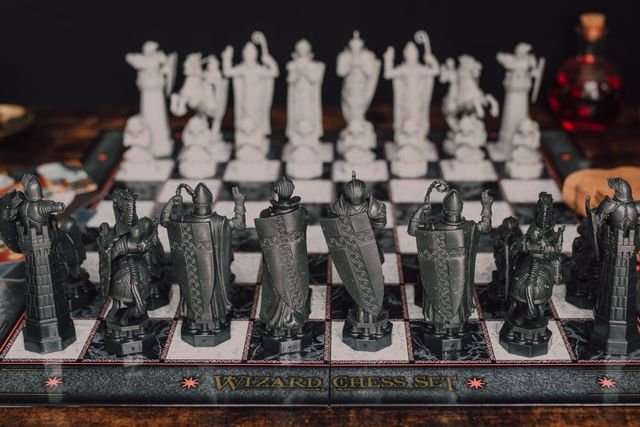
Harry Potter chess scene script explained, including Ron’s sacrifice, the real chess moves, and why the ending matters.
The Harry Potter chess scene script comes from Harry Potter and the Philosopher’s Stone (released as Harry Potter and the Sorcerer’s Stone in the U.S.). Harry, Ron, and Hermione become living black chess pieces, and Ron ultimately sacrifices himself so Harry can reach the white king and finish the game.
The movie’s visible sequence is based on a real chess position created by International Master Jeremy Silman, but the film simplifies the underlying combination.
What You'll Discover:
What Happens in the Harry Potter Chess Scene?
The scene appears near the end of the first Harry Potter film, after the trio passes several magical obstacles protecting the Philosopher’s Stone. They enter a huge enchanted chessboard where the pieces are not merely decorative: they move, fight and destroy opposing pieces when captures occur.
Ron immediately recognizes what they are facing. His familiarity with wizard chess gives him an advantage that Harry and Hermione do not have, so he takes command of the position.
That detail matters. The chessboard is not simply another action sequence; it is specifically Ron’s obstacle. The official Wizarding World site describes the giant chess match as a moment in which Ron’s chess ability, quick thinking and courage finally allow him to take center stage.
The three friends replace black pieces on the board. Harry becomes a bishop, Hermione takes the role of a rook (called a “castle” in the story), and Ron becomes a knight. Their positions are central to the final tactical problem.
Then the game begins.
Harry Potter Chess Scene Script: The Key Dialogue
If you’re searching for the movie script because you want the exact conversation, the most important portion is the sequence in which Ron explains the rules, directs Harry and Hermione into position, realizes what the white queen is threatening, and decides that he must be captured.
The movie’s dialogue is deliberately economical. Ron essentially tells Harry that his sacrifice will create the opportunity for Harry to attack the king, while Hermione objects because she understands that Ron is deliberately putting himself in danger.
The emotional turning point is Ron’s insistence that Harry must continue because reaching the Stone is more important than protecting him from the immediate danger.
That is why the scene lands so strongly even for viewers who know very little about chess: the audience understands the sacrifice before the pieces collide.
For copyright reasons, a full screenplay or transcript isn’t reproduced here. The useful distinction is that the movie script is not the same thing as the complete chess analysis behind the scene.
Why Does Ron Sacrifice Himself?
At the simplest level, Ron sacrifices himself because his knight must be captured to create the winning sequence.
But there is a second layer.
Ron is not randomly volunteering to get knocked off the board. He recognizes that the position requires a sacrifice and understands that Harry is the person who needs to remain in play.
The official Harry Potter site describes the moment as one of Ron’s defining acts of heroism: he recognizes that his friends cannot advance without his sacrifice and makes the decision himself.
That makes the scene a neat character payoff. Earlier in the story, Ron often feels overshadowed by his older brothers and by Harry’s fame. On the chessboard, however, his particular skill becomes indispensable.
The chessboard is Ron’s moment because strategy, rather than fame or book knowledge, determines who can save the group.
What Chess Pieces Do Harry, Ron and Hermione Become?
The assignments are easy to confuse, especially because the film moves quickly.
| Character | Chess piece | Approximate starting square in the composed position | Role |
| Harry Potter | Bishop | a3 | Must survive and deliver the final attack |
| Ron Weasley | Knight | g5 | Directs the game and makes the sacrifice |
| Hermione Granger | Rook | f8 | Must also survive |
| White Queen | Queen | — | Major attacking threat |
| White King | King | — | Final target |
The character-to-piece assignments are documented in analyses of Silman’s position and are consistent with descriptions of the final chess setup.
The symbolism is especially effective because Ron is literally playing the role of the knight while also functioning as the strategist directing the other pieces.
Who Created the Chess Position?
This is one of the most interesting facts that gets lost when people search only for the screenplay.
The chess position was created for the film by International Master Jeremy Silman, who was hired as a chess consultant for Harry Potter and the Sorcerer’s Stone. Chess.com confirms his role and notes that he designed the famous chess scene for the first movie.
Silman wasn’t simply asked to sprinkle a few believable chess moves into the scene. He was tasked with creating a position that would work dramatically while satisfying several storytelling constraints.
The result was an eight-move endgame concept designed around sacrifice, danger and the need to keep Harry and Hermione alive. The Indian Express reports that Silman created the sequence at Chris Columbus’s request and intended it as a chess story running underneath the larger film story.
That is a much richer explanation than the common claim that the chess scene was simply invented by the screenwriter.
What Are the Actual Chess Moves?
Here’s where the movie and the underlying chess composition become especially interesting.
The visible game begins with a recognizable opening idea: White advances a pawn, and Ron responds with a move associated with the Scandinavian Defense. The scene then compresses the action dramatically, showing captures and destruction without presenting every strategic detail to the audience.
The famous composed position has Harry on a3 as the bishop, Ron on g5 as the knight, and Hermione on f8 as the rook. In the position analyzed by chess writers, White’s queen attacks Harry’s bishop, forcing Ron to find a tactical solution.
The crucial idea is a rook sacrifice that draws the queen toward a particular square. Once the queen captures that rook, Ron’s knight can sacrifice itself, allowing Harry’s bishop to deliver the decisive check.
In simplified notation, the important tactical idea is:
Queen captures → rook is offered → queen captures rook → Ron’s knight sacrifices → Harry’s bishop attacks the king.
That sequence explains something the movie does not make obvious: Ron’s sacrifice is not an isolated heroic gesture. It is part of a carefully constructed tactical combination.
Why Doesn’t the Movie Show the Whole Chess Combination?
This is one of the biggest misconceptions surrounding the scene.
People sometimes watch the film and conclude that the chess position doesn’t make sense because several important moves seem to disappear. That’s partly because the movie was edited for storytelling rather than for a tournament-level chess audience.
Jeremy Silman’s intended position contained more strategic information than survives in the final cut. The Leaky Cauldron’s adaptation of Silman’s analysis notes that important chess information was lost when the sequence was converted into a short cinematic action scene.
That editing choice makes sense from a filmmaking perspective.
Imagine stopping an adventure movie to explain why a rook sacrifice clears a square for a bishop several moves later. A chess player might love it. A room full of children waiting to see whether Ron gets smashed by a giant stone queen might not.
So the film prioritizes dramatic clarity over complete chess notation.
Is the Movie Chess Game Actually Legal?
Broadly speaking, yes: the scene is based on real chess principles and a deliberately constructed legal position.
But it shouldn’t be treated as a complete recorded tournament game.
That’s the distinction that resolves many online arguments about the sequence. Silman created a chess composition specifically for a movie, where the moves had to serve narrative requirements that ordinary chess positions do not.
For example, the filmmakers needed the sacrifice to involve Ron rather than Harry or Hermione. The story also required Harry to survive so he could continue toward the Stone.
The underlying puzzle therefore has two simultaneous objectives:
- Win the chess position.
- Make the correct character survive for the story to continue.
Those aren’t necessarily the same thing in ordinary chess.
Could Harry Have Been Sacrificed Instead?
This is where the position gets particularly clever.
Chess analyses of Silman’s composition point out that there can be alternative tactical routes, including one in which Harry’s bishop becomes the sacrifice rather than Ron’s knight. In ordinary chess, the quickest mate may therefore differ from the cinematic solution.
But Harry cannot be sacrificed in the story.
That constraint transforms the puzzle.
Ron has to find a line that wins while preserving Harry and Hermione, which is why his knight becomes the dramatic sacrifice. The chess problem is therefore partly a retrofitted piece of storytelling: the desired emotional outcome helps determine the tactical construction.
Silman’s chess position was designed so that Ron’s sacrifice could function as both a chess tactic and a character decision.
Book vs. Movie: Are the Chess Scenes the Same?
No, and this is important if you’re looking for a “Harry Potter chess scene script.”
The original book gives considerably more room to Ron’s thought process and to the sequence of moves across the board. The movie condenses the action and makes the physical danger much more immediate.
In the book, Ron’s chess knowledge is established as a meaningful part of his character, and his decision to sacrifice himself is tied directly to the rules of the game. The official Wizarding World material also emphasizes that the chess match is Ron’s major opportunity to demonstrate his strategic intelligence.
The film keeps that basic idea but translates it into visual storytelling.
Instead of asking the audience to imagine a complicated chess calculation, it shows enormous stone pieces smashing into each other and makes Ron’s sacrifice physically terrifying.
The result is easier to understand emotionally, even if it is harder to reconstruct precisely as a chess game.
What Does the Chess Scene Symbolize?
The obvious symbolism is sacrifice.
But there is more happening.
Harry, Ron and Hermione each face an obstacle suited to a different strength. Harry’s Quidditch ability helps with the flying keys; Ron’s chess ability becomes crucial on the giant board; Hermione’s knowledge becomes decisive at the potion puzzle. The official Wizarding World account explicitly frames these obstacles as opportunities for different members of the trio to contribute.
That structure quietly establishes one of the series’ most important ideas: being intelligent isn’t the same as being good at everything.
Hermione may have the strongest academic knowledge. Harry may be the famous hero. But on this particular obstacle, Ron is the expert.
And expertise only matters because he is willing to use it for other people.
Why Is Ron’s Sacrifice So Important to His Character?
Ron doesn’t win the chess game by being fearless.
He wins because he can think clearly while everyone else is afraid.
That distinction matters. The scene doesn’t suddenly transform Ron into the strongest wizard in the room. Instead, it gives him a situation where his existing skill finally matters more than his insecurities.
The official Harry Potter editorial team makes the same point: wizard chess gives Ron a rare opportunity to take control, demonstrate strategy and act with confidence.
There is an elegant irony here.
Ron spends much of the first story worrying that he is less impressive than his brothers and less remarkable than Harry. Yet when the trio reaches the chessboard, neither Harry’s fame nor Hermione’s encyclopedic knowledge can replace Ron’s ability.
For a few minutes, the famous boy is following Ron’s instructions.
Why the Scene Still Works So Well
The chess scene has survived as one of the first film’s most memorable sequences because it does three jobs simultaneously.
It advances the plot. It creates genuine physical danger. And it resolves a character question about Ron.
That’s unusually efficient storytelling.
The giant scale helps too. A normal chess sacrifice is abstract: a player moves a piece and accepts its loss. The movie turns that abstraction into something visceral. A capture becomes a stone warrior smashing another stone warrior, and Ron’s knight position becomes a person standing on a horse while knowing exactly what is coming.
That translation from strategy into physical action is the scene’s real cinematic trick.
Common Misconceptions About the Harry Potter Chess Scene Script
“The entire movie chess game was invented without real chess.”
Not quite. Jeremy Silman, an International Master and experienced chess writer, was hired as the film’s chess consultant and created the key position.
“The movie shows every move of Silman’s game.”
It doesn’t. The film compresses the underlying chess sequence, leaving out strategic details that matter when the position is analyzed as actual chess.
“Ron is just randomly sacrificing himself for dramatic effect.”
No. The sacrifice is tied to the tactical solution and the story’s requirement that Harry and Hermione survive.
“Hermione is the knight.”
In the film’s key setup, Ron is the knight, Harry is the bishop, and Hermione is the rook.
“The chess scene is really about Voldemort.”
Not directly. The immediate opponent is the enchanted chess set, and the White Queen is the dangerous piece Ron must account for. The broader symbolism can echo the struggle against Voldemort, but the chessboard itself is one of the magical protections around the Stone.
FAQ
What does Ron say before sacrificing himself?
He explains that his move will allow Harry to attack the king, then insists that Harry continue because stopping the Stone from falling into the wrong hands is more important than Ron’s safety.
What chess piece is Ron in Harry Potter?
Ron becomes the knight in the giant wizard chess game.
What chess piece is Harry?
Harry takes the place of a bishop in the final chess position.
What chess piece is Hermione?
Hermione takes the place of a rook, traditionally called a castle.
Who created the Harry Potter chess position?
International Master Jeremy Silman created the key chess position for Harry Potter and the Sorcerer’s Stone. Chess.com confirms that Silman served as the film’s chess consultant.
Key Takeaways
- The Harry Potter chess scene script belongs to Harry Potter and the Philosopher’s Stone, released in the U.S. as Harry Potter and the Sorcerer’s Stone.
- Ron is the knight, Harry the bishop, and Hermione the rook.
- Ron’s sacrifice is a deliberate tactical idea, not merely a dramatic plot device.
- International Master Jeremy Silman created the important chess position used for the film.
- The movie simplifies the underlying chess combination, so the on-screen sequence is not a complete presentation of Silman’s analysis.
- The chessboard gives Ron a rare chance to demonstrate the skill and confidence that often get overshadowed elsewhere in the story.
- The scene works because it turns an abstract chess sacrifice into a physical, emotional choice: Ron knowingly puts himself in danger so his friends can continue.
Additional Resources
- Official Wizarding World analysis: A useful character-focused explanation of Ron’s chess ability, confidence, strategy and sacrifice.
- Chess biography: Provides background on Silman’s career and confirms his role creating the chess scene for the first Harry Potter film.