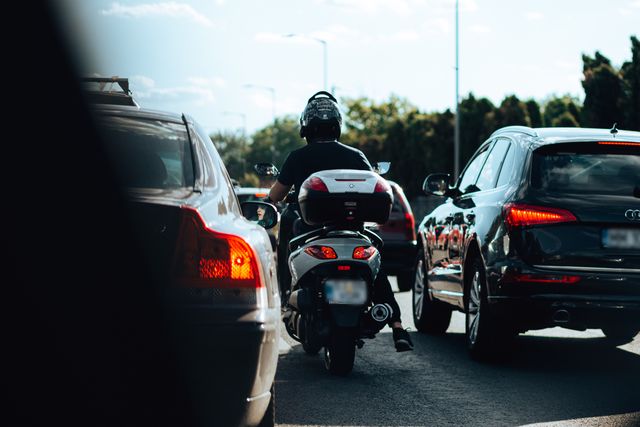
Learn whether lane splitting is legal in Florida, the risks involved, and what the law says to help riders stay safe and informed.
You might be feeling confused, maybe even a bit angry, after a close call on your motorcycle. A car drifted into your space, traffic was crawling, and you did what many riders do in other states. You slipped between lanes to keep moving. Then someone yelled that lane splitting is illegal in Florida, or worse, you ended up in a crash and now you are worried that everyone will blame you and you’re not sure whether you should talk to an accident attorney.
If that sounds familiar, you are not alone. Florida riders often hear mixed messages from friends, social media, and even some officers on the side of the road. Because of this tension, you might wonder where the law actually stands, and what it means for you if you are hurt in a crash while riding in slow or stopped traffic.
Here is the short version. Florida does not allow lane splitting. The law is clear that a motorcycle cannot pass between lanes of traffic. At the same time, that does not automatically erase your rights if another driver hits you. Fault in a crash is rarely all or nothing, and Florida’s shared fault rules still matter.
What You'll Discover:
What exactly does Florida law say about lane splitting?
To understand your position, you need to know what the statute actually says, not just what someone heard from a friend. Florida’s motorcycle law on lane usage is found in section 316.209 of the Florida Statutes. It explains how motorcycles can use a lane and where the line is drawn for passing.
Under this law, a motorcycle is entitled to the full use of a lane, just like a car. Drivers of larger vehicles are not allowed to crowd you or share your lane unless you choose to ride side by side with another motorcycle. However, the same statute also says a motorcycle cannot overtake and pass in the same lane that is occupied by the vehicle being passed. In plain English, you cannot ride up between a car and the edge of the same lane to pass it.
The law also says a motorcycle cannot operate between lanes of traffic or between adjacent lines or rows of vehicles. That is the legal definition of lane splitting in Florida. If you want to read the exact wording, you can review Florida Statute 316.209 on motorcycle lane usage.
So where does that leave you when traffic is crawling, the sun is baking your gear, and you watch out-of-state videos where riders thread through traffic as if it were normal? It leaves you in a state that currently says no to lane splitting, even when other places are starting to allow it in limited ways.
Why is lane splitting banned, and how does that affect your safety?
On paper, lawmakers say lane splitting is banned for safety. The concern is that drivers in heavy traffic do not expect a motorcycle to appear between lanes. They may change lanes suddenly, open a door, or drift while looking at their phones. That mismatch between what drivers expect and what riders sometimes do is where many close calls begin.
Imagine this. You are on a busy interstate in stop-and-go traffic. Cars are stacked up, brake lights everywhere. You move between the lanes at a low speed, trying to avoid overheating your engine and your body. A driver suddenly decides to squeeze into a gap in the next lane without signaling. They never checked their blind spot. You are already there. The impact sends you to the ground. Now you are injured, your bike is damaged, and everyone is pointing fingers.
This is where the emotional and financial side hits. You may be worried that because lane splitting is illegal in Florida, you are automatically at fault, that insurance will deny your claim, and that your medical bills will fall squarely on your shoulders. You might also feel angry, because the driver never looked, and you feel they share blame.
Florida uses a comparative negligence system. That means fault can be shared between people. Even if you violated the lane splitting rule, the other driver can still be found partly responsible if they were careless, such as changing lanes without signaling or following too closely. Your recovery could be reduced if you are partly at fault, but it is not always wiped out completely.
On top of that, the risks of trying to handle all of this alone are real. Insurance companies know the law. They may latch onto the illegal lane splitting issue and try to shut down your claim early. When you are in pain, worried about work, and trying to keep your life together, that pressure can be crushing.
How do the risks and choices around lane splitting in Florida compare?
You might be weighing your options every time traffic slows. Do you stay in line and risk being rear ended, or do you move between cars and risk a ticket or blame if something goes wrong? There is no perfect answer, but it helps to see the tradeoffs clearly.
| Choice or Situation | Short term benefit | Main legal risk | Crash and injury impact |
| Stay in your lane in heavy traffic | Clear compliance with Florida law | Lower risk of traffic citation | Still risk of being rear ended by distracted drivers |
| Lane split in slow or stopped traffic | Less time in stop-and-go traffic, reduced overheating | Violation of 316.209, possible ticket, used against you in a claim | Higher risk of sideswipe from sudden lane changes or door opening |
| Filter to the front at a red light | Shorter wait time, less exposure between vehicles | Treated as operating between lanes. Same illegality as lane splitting | Risk from cars turning right or jumping the green without seeing you |
| After a crash while lane splitting | Possible argument that other driver also acted negligently | Comparative fault may reduce your recovery | Medical bills, lost wages, and pain may still be partially recoverable |
When you look at it this way, the law is trying to discourage behavior the state sees as risky, but it does not erase the reality that many crashes happen because car drivers are not paying attention. That is where a personal injury lawyer can step in to sort out how fault should really be assigned based on the full story, not just one label like “lane splitting.”
What steps can you take right now if you are worried about a lane splitting crash?
1. Document everything while your memory is fresh
If you were involved in a crash, write down what happened as soon as you can. Include your speed, traffic conditions, whether vehicles were stopped or moving, weather, and anything the other driver said at the scene. Keep copies of any photos, medical records, and the police report. If the report mentions lane splitting, do not panic. That is only one piece of the puzzle and can still be challenged or explained.
2. Learn the basics of Florida’s motorcycle safety guidance
Even if you have been riding for years, it can help to see what state safety experts recommend. The Florida Department of Transportation offers information focused on motorcycle awareness and rider safety. Reviewing these materials can help you show that you take safety seriously, and it can sometimes support your case by highlighting driver responsibilities as well. You can explore the state’s guidance through the FDOT motorcycle safety resources.
3. Talk with a lawyer before you speak at length with insurance adjusters
Insurance adjusters may sound friendly, but their job is to limit the payout on your claim. If they hear that you were engaged in Florida motorcycle lane splitting, they may try to use that alone to deny or shrink your claim. A personal injury attorney who understands motorcycle law can help you present the facts in a way that reflects the full picture. That includes the other driver’s behavior, visibility, traffic patterns, and whether your actions were actually the main cause of the crash.
Where do you go from here after a lane splitting scare or crash?
You might still be carrying the shock of a close call or the weight of an actual collision. Your gear might be scuffed, your bike damaged, and your body sore in ways that keep surprising you. On top of that, there is the fear that one decision in slow traffic will overshadow everything else and leave you with nothing.
You do not have to sort this out alone. Understanding that lane splitting laws in Florida are strict is only the first step. The next step is recognizing that fault in a crash is rarely simple, and that you still have rights, even if you made a choice the law does not allow.
Reach out to a qualified personal injury lawyer who truly understands riders and Florida traffic law. Share what happened in detail. Ask the hard questions about fault, recovery, and what you can realistically expect. With the right guidance, you can move from confusion toward clarity, and from fear about the law toward a plan for healing and financial recovery.
Contact an Attorney in Florida
Weber Injury Law
7710 Massachusetts Avenue
New Port Richey, Florida 34653