Plan a value-for-money Great Migration safari with budget-friendly tips to enjoy epic wildlife without overspending.
For many people, an overseas holiday is a short break to splurge at a luxury hotel and eat out at bougie restaurants. But for me , travelling is a long-term lifestyle, and the more Iwe can save along the way, the longer I can stay on the road.
If you have ever looked into booking an African safari, you’ve probably had a minor heart attack at the prices – but don’t worry, I got you. Seeing the Great Migration, the breathtaking event where millions of wildebeest, zebras, and gazelles stampede across the East African plains, is a total bucket-list experience.
It is entirely possible to experience this natural wonder on a medium budget, balancing rustic simplicity with a little bit of comfort. You will get the same epic wildlife viewing on a budget without completely destroying your bank account.
Here is my ultimate guide to planning a value-for-money Great Migration safari that gives you the absolute best of both worlds.
What You'll Discover:
Tanzania or Kenya: Where is the Best Value?
One of the biggest questions travellers ask is whether you should book your migration safari in Tanzania or Kenya.
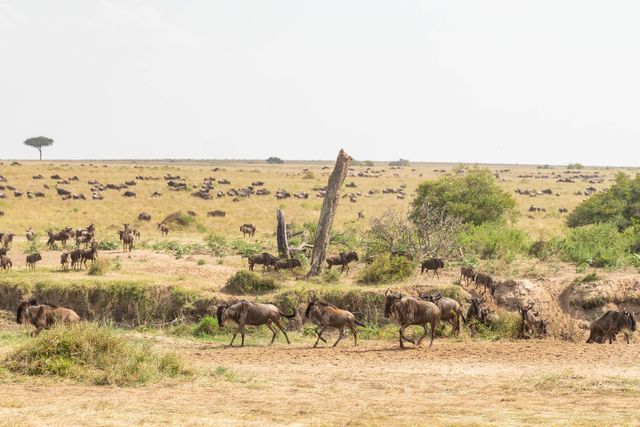
The truth is, the Great Migration isn’t a single event; it is a continuous, year-round loop. The herds journey through the Serengeti in Tanzania before heading up into the Masai Mara in Kenya, following the seasonal rains in search of fresh green pastures.
Because the animals are constantly moving, your budget will largely depend on when and where you catch them. The migration calendar is generally split into two main seasons: the green season and the dry season.
The Green Season (Calving Season)
Between January and March, the heavy rains transform Tanzania’s Serengeti into a stunning landscape of lush green pastures and wildflowers. This is the calving season, where hundreds of thousands of wildebeest give birth to around 200,000 babies. It is an incredible thing to witness, and because the thick vegetation can make spotting wildlife a little more challenging, safari operators offer heavily reduced rates. If you want a cheaper safari with fewer crowds, this would be a fantastic time to go.
The Dry Season (Predator Season)
From July to September, the rain stops, and the thick grasses begin to thin out. The herds are incredibly easy to spot because they are forced into the open to find waterholes. This means they also become an easy target for the predators hunting them. This drama results in this being the peak safari season, meaning it is the most expensive time of year.
This is also when the iconic Mara River crossings happen, which you can access from either the Kenyan or Tanzanian side. It is the most dramatic, action-packed time to go, but you will pay a premium for it.
The Budget-Friendly Alternative: The Grumeti River Crossing
If you want the thrill of a river crossing without the peak-season price tag of a September Mara River tour, look into booking a mid-budget safari in June around the Grumeti River in the Serengeti.
The Grumeti is a smaller river compared to the massive Mara River, but it still presents a treacherous obstacle for the migrating herds. Watching the wildebeest braving the waters here is just as thrilling, but because it falls just before the absolute peak season madness, you can find much better value-for-money itineraries.
The Ultimate Safari Balancing Act
When you are trying to stretch your dollars on a safari, two major things will dictate your final cost: the length of your stay and your choice of accommodation.
You don’t have to rough it completely in a tiny nylon tent if that isn’t your vibe, though joining a group camping safari is easily my favorite way to keep costs down.
If you want more comfort, I find that mid-range safari style is all about glamping, consider staying in permanent tented camps that feature real beds and en-suite bathrooms, giving you that classic African wilderness atmosphere.
The main differences between mid-range and luxury lodges aren’t the wildlife you see, but the little extras like private butlers or plunge pools. By skipping the unnecessary opulence and choosing group tours or mid-range camps, you can easily save thousands of dollars while spending your days out in the same treasured national parks.
Maximise Your Budget by Adding Beach Time
Do you want to know the best trick for lowering the average daily cost of an African safari trip? Pair your migration safari with a beach holiday!
Whether you choose the pristine coastline of Kenya or the exotic beaches of Zanzibar in Tanzania, coastal accommodation and beachside living are significantly cheaper per day than being on an all-inclusive safari. Spending four or five days tracking wildlife and then heading to the coast balances out your budget beautifully.