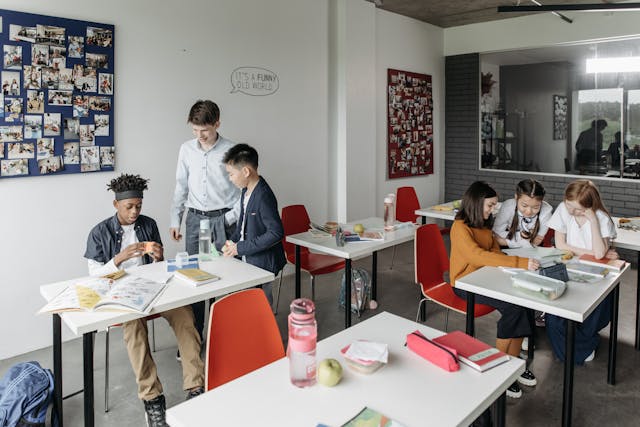
Discover how the LJCDS Hub for Human Impact empowers students through innovation, collaboration, and real-world problem solving.
The LJCDS Hub for Human Impact is a three-story, 20,000-square-foot learning and innovation center at La Jolla Country Day School designed to connect education with real-world impact.
It encourages collaboration, design thinking, and service learning so students can turn knowledge into meaningful change in their communities and beyond.
A lot of us remember school as something predictable.
You walked into a classroom. Sat at a desk. Took notes. Studied for the test. Then repeated the cycle again the next day.
It worked, technically. Students learned information. Grades were assigned. Diplomas were eventually handed out.
But somewhere along the way, a quiet question started floating around modern education.
What if learning wasn’t supposed to stay inside the classroom?
That question sits at the heart of the LJCDS Hub for Human Impact, a new educational initiative at La Jolla Country Day School. And the more you explore the idea behind it, the more it feels less like a building project and more like a shift in philosophy.
Instead of asking students to memorize answers, the hub asks them to explore problems.
Instead of separating subjects into neat boxes, it encourages connections between science, technology, culture, and community.
It’s education designed around impact.
And that small shift changes everything.
What You'll Discover:
What Is the LJCDS Hub for Human Impact?
The LJCDS Hub for Human Impact is a collaborative learning center designed to bring together innovation, interdisciplinary education, and real-world problem solving.
Spanning roughly 20,000 square feet across three stories, the hub functions as a central space where students can explore ideas, experiment with solutions, and collaborate across academic disciplines.
But the real purpose of the hub goes beyond architecture.
It exists to create a learning environment where students connect their knowledge to real-world impact.
In simple terms, it transforms education from something passive into something active.
Students are not just learning about the world.
They are learning how to shape it.
Why the LJCDS Hub for Human Impact Exists
Education systems around the world are quietly facing the same challenge.
The world has become unpredictable.
Technology evolves faster than curricula. Global issues intersect with local communities. Entire industries transform within a decade.
The traditional model of education — learn facts, take exams, graduate — struggles to keep up with this pace of change.
Schools are beginning to rethink what learning should look like.
The LJCDS Hub for Human Impact reflects this shift. Its goal is to prepare students for a future where adaptability, collaboration, and innovation are just as important as academic knowledge.
Students are encouraged to move beyond memorization and toward exploration.
They learn to ask better questions.
They learn to build ideas.
They learn to test solutions.
And most importantly, they learn that education can create real impact.
Inside the Hub: A Space Designed for Collaboration
One of the most interesting ideas behind the LJCDS Hub for Human Impact is that the building itself plays a role in the learning process.
Educational designers sometimes describe the environment as the “third teacher.”
The first teacher is the instructor.
The second is the curriculum.
The third is the physical environment where learning takes place.
The hub embraces this concept by creating spaces that encourage curiosity, experimentation, and collaboration.
The Bridge
At the center of the building is a multi-purpose bridge that connects different parts of the hub.
It is more than a passageway.
The bridge acts as a collaborative gathering area where students can meet, exchange ideas, and discuss projects.
This type of space encourages spontaneous conversations that often lead to unexpected insights.
Sometimes innovation begins with a simple question between two students who happened to cross paths.
Design and Innovation Centers
The hub includes dedicated Design and Innovation centers where students can experiment with engineering concepts, technology prototypes, and creative solutions.
These labs allow students to move from theory to practice.
Instead of simply learning how something works, they can design their own solutions.
For example, a project might start as a classroom discussion about environmental sustainability.
Soon students are sketching ideas, building prototypes, and testing whether their designs could solve real problems.
The gap between learning and doing begins to disappear.
Flexible Collaboration Rooms
Traditional classrooms often follow the same formula: desks facing the front of the room.
The hub breaks away from that structure.
Its collaboration rooms are flexible spaces designed for different types of learning experiences.
A room might function as a brainstorming workshop one day, a presentation space the next, and a design lab later in the week.
This adaptability reflects how real work happens outside school.
Problems rarely arrive in neatly labeled categories.
They require collaboration and creativity.
Programs That Power the Hub
The LJCDS Hub for Human Impact supports several educational programs that encourage students to apply knowledge in meaningful ways.
Each program contributes to the broader mission of connecting learning with real-world impact.
Design and Innovation
Students are introduced to design thinking — a problem-solving approach used by engineers, entrepreneurs, and creative professionals.
The process often follows five steps:
- Identify a problem
- Research the issue deeply
- Design possible solutions
- Build and test prototypes
- Improve through iteration
This method teaches students how innovation actually happens.
Ideas rarely appear fully formed.
They evolve through experimentation.
Global Education
The hub also supports programs focused on global awareness.
Students explore international issues such as environmental challenges, cultural exchange, and diplomatic problem solving.
Programs like Model United Nations allow students to debate global policies and represent different countries in simulated negotiations.
These experiences help students understand the interconnected nature of modern societies.
Media Literacy
In today’s digital world, information spreads rapidly.
But not all information is accurate.
Media literacy programs teach students how to evaluate sources, recognize bias, and identify misinformation.
Students learn to question what they read and analyze how narratives are constructed.
Critical thinking becomes an essential life skill.
Service Learning
Service learning plays a major role in the mission of the LJCDS Hub for Human Impact.
Students apply what they learn in the classroom to projects that benefit communities.
These initiatives might include environmental sustainability programs, social impact campaigns, or community development efforts.
Education becomes connected to empathy.
Students begin to see how their ideas can improve lives.
Skills the Hub Helps Students Develop
Beyond academic knowledge, the LJCDS Hub for Human Impact focuses on skills that prepare students for a rapidly changing world.
Conceptual Integration
Modern problems rarely belong to a single field.
Climate change, for example, involves science, economics, politics, and technology.
Students learn to approach problems from multiple perspectives and combine insights from different disciplines.
This type of thinking encourages deeper understanding.
Skill Transfer
One of the challenges many students face is applying what they learn in one subject to another.
The hub encourages skill transfer.
Mathematics might inform engineering designs. Communication skills might support leadership projects. Scientific research might guide environmental initiatives.
Knowledge becomes interconnected.
Real-World Relevance
Perhaps the most powerful element of the hub is the focus on real-world relevance.
Students work on projects that mirror real challenges faced by communities and organizations.
Instead of asking, “Will this be on the test?” students begin asking, “Could this solution actually work?”
That mindset changes the entire learning experience.
The Bigger Vision Behind the Hub
The LJCDS Hub for Human Impact represents more than an educational facility.
It reflects a broader shift in how schools think about preparing students for the future.
Success in modern society requires more than academic knowledge.
It requires curiosity.
It requires adaptability.
It requires the ability to collaborate with people who see the world differently.
Students who grow up in environments that encourage these skills are more likely to become thoughtful leaders.
They learn how to navigate complexity.
They learn how to ask better questions.
And they learn that ideas only matter when they create meaningful change.
Traditional Learning vs the Hub Model
| Feature | Traditional School Model | LJCDS Hub for Human Impact |
| Classroom Design | Fixed desks and lecture format | Flexible collaboration spaces |
| Learning Structure | Separate academic subjects | Interdisciplinary learning |
| Student Role | Passive knowledge receivers | Active problem solvers |
| Project Style | Mostly theoretical assignments | Real-world problem solving |
| Collaboration | Limited interaction | Core learning principle |
This comparison highlights the philosophy behind the hub.
It is not simply a modern building.
It represents a new way of thinking about education.
Frequently Asked Questions
What is the LJCDS Hub for Human Impact?
The LJCDS Hub for Human Impact is a three-story learning center designed to support collaboration, innovation, and real-world problem solving for students.
Where is the hub located?
The hub is located at La Jolla Country Day School in California, serving students from early childhood through high school.
What makes the hub unique?
The hub emphasizes interdisciplinary education, design thinking, and service learning while providing flexible spaces for collaboration and experimentation.
Who benefits from the hub?
Students across multiple grade levels benefit from the programs and collaborative spaces offered within the hub.
What skills does the hub focus on?
Key skills include innovation, critical thinking, leadership, collaboration, and community impact.
Key Takings
- The LJCDS Hub for Human Impact is a collaborative learning center designed to connect education with real-world impact.
- The hub promotes interdisciplinary learning through design thinking, innovation labs, and global education programs.
- Flexible learning spaces encourage creativity, collaboration, and experimentation.
- Students are challenged to apply knowledge to real-world problems instead of focusing only on theoretical learning.
- Service learning initiatives help students understand how education can benefit communities.
- The hub prepares students with critical thinking, leadership, and adaptability skills for the future.
- The initiative reflects a growing shift toward impact-driven education.